
??
| 中文名稱 | G蛋白轉(zhuǎn)錄因子α3抗體 |
| 別????名 | GDCA; Ggust; Gnat 3; GNAT3; GNAT3_HUMAN; Gtn; Guanine nucleotide binding protein alpha transducing 3; Guanine nucleotide binding protein G(t) subunit alpha 3; Guanine nucleotide-binding protein G(t) subunit alpha-3; Gustducin alpha 3; Gustducin alpha 3 chain.?? |
| 研究領(lǐng)域 | 腫瘤??細(xì)胞生物??神經(jīng)生物學(xué)??細(xì)胞周期蛋白??通道蛋白??G蛋白信號?? |
| 抗體來源 | Rabbit |
| 克隆類型 | Polyclonal |
| 交叉反應(yīng) | Human,?Mouse,?Rat,? (predicted: Dog,?Pig,?Cow,?Horse,?Rabbit,?Sheep,?) |
| 產(chǎn)品應(yīng)用 | WB=1:500-2000?ELISA=1:500-1000?IHC-P=1:100-500?IHC-F=1:100-500?IF=1:100-500?(石蠟切片需做抗原修復(fù)) not yet tested in other applications. optimal dilutions/concentrations should be determined by the end user. |
| 分?子?量 | 40kDa |
| 細(xì)胞定位 | 細(xì)胞漿? |
| 性????狀 | Liquid |
| 濃????度 | 1mg/ml |
| 免?疫?原 | KLH conjugated synthetic peptide derived from human GNAT3:2-50/354? |
| 亞????型 | IgG |
| 純化方法 | affinity purified by Protein A |
| 儲?存?液 | 0.01M TBS(pH7.4) with 1% BSA, 0.03% Proclin300 and 50% Glycerol. |
| 保存條件 | Shipped at 4℃. Store at -20 °C for one year. Avoid repeated freeze/thaw cycles. |
| PubMed | PubMed |
| 產(chǎn)品介紹 | Heterotrimeric G proteins function to relay information from cell surface receptors to intracellular effectors. Each of a very broad range of receptors specifically detects an extracellular stimulus (a photon, pheromone, odorant, hormone or neurotransmitter) while the effectors (e.g., adenyl cyclase), which act to generate one or more intracellular messengers, are less numerous. In mammals, G protein alpha, beta and gamma polypeptides are encoded by at least 16, 4 and 7 genes, respectively. Most interest in G proteins has been focused on their alpha subunits, since these proteins bind and hydrolyze GTP and most obviously regulate the activity of the best studied effectors. Four distinct classes of Ga subunits have been identified; these include Gs, Gi, Gq and Ga 12/13. Gustducin has been identified as a taste-cell-specific G protein within the Gi subclass of Ga subunit proteins that is most closely related to the transducins and exclusively expressed in taste buds. Function: Guanine nucleotide-binding protein (G protein) alpha subunit playing a prominent role in bitter and sweet taste transduction as well as in umami (monosodium glutamate, monopotassium glutamate, and inosine monophosphate) taste transduction. Transduction by this alpha subunit involves coupling of specific cell-surface receptors with a cGMP-phosphodiesterase; Activation of phosphodiesterase lowers intracellular levels of cAMP and cGMP which may open a cyclic nucleotide-suppressible cation channel leading to influx of calcium, ultimately leading to release of neurotransmitter. Indeed, denatonium and strychnine induce transient reduction in cAMP and cGMP in taste tissue, whereas this decrease is inhibited by GNAT3 antibody. Gustducin heterotrimer transduces response to bitter and sweet compounds via regulation of phosphodiesterase for alpha subunit, as well as via activation of phospholipase C for beta and gamma subunits, with ultimate increase inositol trisphosphate and increase of intracellular Calcium. GNAT3 can functionally couple to taste receptors to transmit intracellular signal: receptor heterodimer TAS1R2/TAS1R3 senses sweetness and TAS1R1/TAS1R3 transduces umami taste, whereas the T2R family GPCRs act as bitter sensors. Functions also as lumenal sugar sensors in the gut to control the expression of the Na+-glucose transporter SGLT1 in response to dietaty sugar, as well as the secretion of Glucagon-like peptide-1, GLP-1 and glucose-dependent insulinotropic polypeptide, GIP. Thus, may modulate the gut capacity to absorb sugars, with implications in malabsorption syndromes and diet-related disorders including diabetes and obesity. Subunit: G proteins are composed of 3 units; alpha, beta and gamma, respectively GNAT3, GNB1 and GNG13 for Gustducin heterotrimer for bitter taste transduction. The alpha chain contains the guanine nucleotide binding site. Gustducin heterotrimer may also be composed of GNAT3, GNB3 and GNG13. Subcellular Location: Cytoplasm. Dual ditribution pattern; plasmalemmal pattern with apical region localization and cytosolic pattern with localization throughout the cytoplasm. Tissue Specificity: Expressed in taste buds (sensory organs of clustered epithelial cells) of the circumvallate and foliate papillae of the tongue at protein level. Expressed in enteroendocrine L cells of the gut. Detected also in spermatozoa. Post-translational modifications: Potential N-myristoylation may anchor alpha-subunit to the inner surface of plasma membrane. Similarity: Belongs to the G-alpha family. G(i/o/t/z) subfamily. SWISS: A8MTJ3 Gene ID: 346562 Database links: Entrez Gene: 346562?Human Entrez Gene: 242851?Mouse Entrez Gene: 286924?Rat Omim: 139395?Human SwissProt: A8MTJ3?Human SwissProt: Q3V3I2?Mouse SwissProt: P29348?Rat Unigene: 335049?Human Unigene: 332230?Mouse Unigene: 10456?Rat Important Note: This product as supplied is intended for research use only, not for use in human, therapeutic or diagnostic applications. ? |
| 產(chǎn)品圖片 | 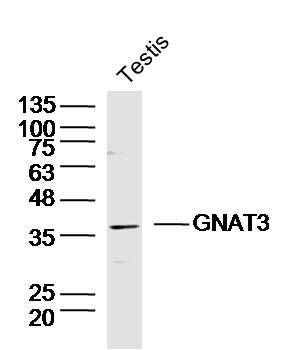 Sample: Testis (Mouse) Lysate at 40 ug Sample: Testis (Mouse) Lysate at 40 ugPrimary: Anti-GNAT3 (bs-6149R) at 1/300 dilution Secondary: IRDye800CW Goat Anti-Rabbit IgG at 1/20000 dilution Predicted band size: 40 kD Observed band size: 40 kD  Sample: A549 Cell Lysate at 40 ug Sample: A549 Cell Lysate at 40 ugPrimary: Anti-GNAT3 (bs-6149R) at 1/300 dilution Secondary: IRDye800CW Goat Anti-Rabbit IgG at 1/20000 dilution Predicted band size: 40 kD Observed band size: 40 kD  Paraformaldehyde-fixed, paraffin embedded (rat testis); Antigen retrieval by boiling in sodium citrate buffer (pH6.0) for 15min; Block endogenous peroxidase by 3% hydrogen peroxide for 20 minutes; Blocking buffer (normal goat serum) at 37°C for 30min; Antibody incubation with (GNAT3) Polyclonal Antibody, Unconjugated (bs-6149R) at 1:500 overnight at 4°C, followed by a conjugated secondary (sp-0023) for 20 minutes and DAB staining.Tissue/cell: rat brain tissue; 4% Paraformaldehyde-fixed and paraffin-embedded; Paraformaldehyde-fixed, paraffin embedded (rat testis); Antigen retrieval by boiling in sodium citrate buffer (pH6.0) for 15min; Block endogenous peroxidase by 3% hydrogen peroxide for 20 minutes; Blocking buffer (normal goat serum) at 37°C for 30min; Antibody incubation with (GNAT3) Polyclonal Antibody, Unconjugated (bs-6149R) at 1:500 overnight at 4°C, followed by a conjugated secondary (sp-0023) for 20 minutes and DAB staining.Tissue/cell: rat brain tissue; 4% Paraformaldehyde-fixed and paraffin-embedded;Antigen retrieval: citrate buffer ( 0.01M, pH 6.0 ), Boiling bathing for 15min; Block endogenous peroxidase by 3% Hydrogen peroxide for 30min; Blocking buffer (normal goat serum,C-0005) at 37℃ for 20 min; Incubation: Anti-GNAT3 Polyclonal Antibody, Unconjugated(bs-6149R) 1:200, overnight at 4°C, followed by conjugation to the secondary antibody(SP-0023) and DAB(C-0010) staining |
?