
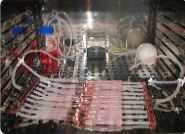
軟骨灌流離體剪切應力組織工程3D培養生物反應器
產品名稱: 軟骨灌流離體剪切應力組織工程3D培養生物反應器
英文名稱:
產品編號: TEB
產品價格: 0
產品產地: 西班牙
品牌商標: ebers
更新時間: null
使用范圍: null
- 聯系人 :
- 地址 : 中國上海上海上海市
- 郵編 : 201112
- 所在區域 : 上海
- 電話 : 180****9478 點擊查看
- 傳真 : 點擊查看
- 郵箱 : brightzhou@micoforce.com
灌流軟骨生物反應器(perfusion cartilage bioreactors)原理為連續添加培養液至培養艙,同時也吸出相同體積的原有培養液,使槽內培養液體積維持一定,養分也能維持在細胞生長所需范圍以上,細胞代謝產物則不會堆積太多。培養時將已完成種植細胞的支架固定于灌流系統中,培養基直接流過支架之孔隙,流體可在支架的截面均勻分布,讓接種的細胞隨之均勻注入多孔支架中貼附培養。灌流可是密閉系統,經由另一個培養液容器再循環回到原先之培養槽。此外,灌流反應器克服了機械混合產生的剪應力,且不會產生中間壞死的情況。若對細胞的周圍環境包括pH值、溫度、培養液的營養成分、代謝產物等,作精確的監測和控制,培養細胞的密度及質量可以提高。 EBER Effect of the Shear Stress in the Human Bone Marrow Mesenchymal Stem Cell Behavior Clara Alcaine1,2, Sonia Santander1,2, Ignacio Ochoa1,2, Jose Manuel Garcia-Aznar1,2, Manuel Doblare1,2 Corresponding Author: iochgar@unizar.es 1 Group of Structural Mechanics and Materials Modelling (GEMM). Aragón Institute of Engineering Research (I3A). Universidad de Zaragoza, Spain 2 Centro de Investigación Biomédica en Red en Bioingeniería, Biomateriales y Nanomedicina (CIBER-BBN) Aragón Institute of Health Sciences, Spain Introduction Shear stress has been previously reported to be a powerful differentiation stimuli (1,2). However, other effects (proliferation, migration) on Human Bone Marrow Mesenchymal Stem Cells (MSCs) have not been deeply studied. Our main goal is to determine if the shear stress is able to affect not only differentiation but also other important cell processes such as cell proliferation, migration or cell adhesion. Materials and Methods Bone Marrow Mesenchymal Stem Cells have been seeded in μ-Slide I flow kit (Ibidi) and cultured under a shear stress of 5 dynes /cm2 in a perfusion bioreactor (TEB-1000, EBERS) for 7 days. Proliferation was determined after cell counting and apoptosis (Annexin V) was measured with flow citometry techniques. Migration experiments were performed in a multidimensional microscope for 24 hours. Inmunofluorescent staining to determine the cell area and cytoskeleton organization was carried out in a confocal microscope. Expression of the cell adhesion molecules was determined by RTPCR. ANOVA and t-student tests were carried out to determine statistical differences. Results Significant differences in cell proliferation have been observed after 7 days between static and shear stimulated cells (Fig.1). However, no significant differences in apoptosis were obtained between both studied groups (Fig.2). Differences in cell area, speed of migration, cytoskeleton organization and adhesion molecules has been also observed. In a future, we will try to determine the effect of different shear stress ratios on the previously described variables.