

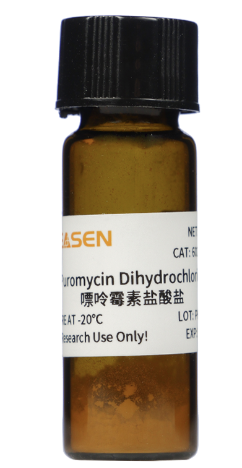
Puromycin Dihydrochloride 嘌呤霉素鹽酸鹽
產(chǎn)品名稱: Puromycin Dihydrochloride 嘌呤霉素鹽酸鹽
英文名稱: Puromycin Dihydrochloride 嘌呤霉素鹽酸鹽
產(chǎn)品編號: 60210ES25
產(chǎn)品價格: 詢價
產(chǎn)品產(chǎn)地: 翌圣生物
品牌商標(biāo): Yeasen
更新時間: 2026-02-09T14:52
使用范圍: null
翌圣生物科技(上海)股份有限公司
- 聯(lián)系人 : 李自轉(zhuǎn)
- 地址 : 上海市浦東新區(qū)天雄路166弄一號樓三層南單元
- 郵編 : 200030
- 所在區(qū)域 : 上海
- 電話 : 139****5640 點(diǎn)擊查看
- 傳真 : 點(diǎn)擊查看
- 郵箱 : lizizhuan@yeasen.com
- 二維碼 : 點(diǎn)擊查看
產(chǎn)品介紹
嘌呤霉素(Puromycin)是由白黑鏈霉菌(Streptomycesalboniger)發(fā)酵代謝產(chǎn)生的一種氨基糖苷類抗生素,通過抑制蛋白質(zhì)合成而殺死革蘭氏陽性菌,各種動物和昆蟲細(xì)胞。某種特殊情況下有效作用大腸桿菌。作用機(jī)制在于嘌呤霉素是氨酰-tRNA分子3´末端的類似物,能夠與核糖體的A位點(diǎn)結(jié)合并摻入到延伸的肽鏈中。嘌呤霉素同A位點(diǎn)結(jié)合后,不會參與隨后的任何反應(yīng),從而導(dǎo)致蛋白質(zhì)合成的提前終止并釋放出C-末端含有嘌呤霉素的不成熟多肽。
嘌呤霉素產(chǎn)生菌Streptomycesalboniger內(nèi)發(fā)現(xiàn)的pac基因編碼嘌呤霉素N-乙酰轉(zhuǎn)移酶(PAC),賦予機(jī)體對嘌呤霉素產(chǎn)生抗性。這一特性如今普遍應(yīng)用于篩選特定攜帶pac基因質(zhì)粒的哺乳動物穩(wěn)定轉(zhuǎn)染細(xì)胞株。
嘌呤霉素在細(xì)胞穩(wěn)轉(zhuǎn)株篩選中的普遍應(yīng)用與慢病毒載體的特性有關(guān),現(xiàn)在商業(yè)化的慢病毒載體多數(shù)都攜帶pac基因。在某些特定情況下,嘌呤霉素亦可以用來篩選轉(zhuǎn)化攜帶pac基因質(zhì)粒的大腸桿菌菌株。
產(chǎn)品性質(zhì)
|
CAS 號(CAS NO.)
|
58-58-2
|
|
英文別名(English Synonym)
|
Puromycin
|
|
中文名稱(Chinese Name)
|
嘌呤霉素
|
|
分子量(Molecular Weight)
|
544.43 g/mol
|
|
外觀(Appearance)
|
白色至米白色粉末
|
|
純度(Purity)
|
≥98%
|
產(chǎn)品特色
本產(chǎn)品在常溫下穩(wěn)定,避免高溫和酸堿環(huán)境。對多種革蘭氏陽性菌和革蘭氏陰性菌有效,特別是對鏈球菌、肺炎球菌等有強(qiáng)效。對哺乳動物細(xì)胞也有一定毒性。
研究應(yīng)用:
- 作為抗生素篩選工具,用于研究細(xì)菌耐藥性。
- 用于細(xì)胞培養(yǎng)中防止細(xì)菌污染。
使用說明
1. 建議使用濃度
哺乳動物細(xì)胞:1-10 μg/mL,最佳濃度需要?dú)缜€來確定。
大腸桿菌:LB瓊脂培養(yǎng)基篩選穩(wěn)定轉(zhuǎn)化pac基因的大腸桿菌,使用濃度為125 μg/mL。
【注】:使用嘌呤霉素篩選大腸桿菌穩(wěn)轉(zhuǎn)株需要精確的pH值調(diào)節(jié),而且受宿主細(xì)胞本身的影響。
2.溶解方法
用蒸餾水溶解嘌呤霉素配制成50 mg/mL的母液,經(jīng)0.22 μm濾膜過濾除菌后分裝于-25~-15℃凍存;也可溶于甲醇,配制成10 mg/mL的儲存液。
3. 嘌呤霉素殺滅曲線的確定(以shRNA轉(zhuǎn)染或者慢病毒轉(zhuǎn)導(dǎo)為例)
嘌呤霉素有效篩選濃度跟細(xì)胞類型、生長狀態(tài)、細(xì)胞密度、細(xì)胞代謝情況及細(xì)胞所處細(xì)胞周期位置等有關(guān)。為了篩選到穩(wěn)定表達(dá)的shRNA細(xì)胞株,確定殺死未轉(zhuǎn)染/轉(zhuǎn)導(dǎo)細(xì)胞的最低濃度嘌呤霉素至關(guān)重要。建議初次做實驗的客戶一定要建立適合自身實驗體系的殺死曲線(kill curve)。
1)Day 1:24孔板內(nèi)以5~8×10⁴ cells/孔的密度鋪板,鋪足夠量的孔以進(jìn)行后續(xù)的梯度實驗。37℃細(xì)胞孵育過夜。
2)Day 2:①準(zhǔn)備篩選培養(yǎng)基:含不同濃度嘌呤霉素的新鮮培養(yǎng)基(如0-15 μg/mL,至少5個梯度);②往孵育過夜后的細(xì)胞內(nèi)更換新鮮配制的篩選培養(yǎng)基;之后37℃孵育細(xì)胞。
3)Day 4:更換新鮮的篩選培養(yǎng)基,并觀察細(xì)胞存活率。
4)根據(jù)細(xì)胞的生長狀態(tài),約2-3天更換新鮮的篩選培養(yǎng)基。
5)每日監(jiān)測細(xì)胞,觀察存活細(xì)胞率,從而確定抗生素篩選開始4-6天內(nèi)有效殺死非轉(zhuǎn)染或所有非轉(zhuǎn)導(dǎo)細(xì)胞的藥物最低濃度。
4. 哺乳動物穩(wěn)定轉(zhuǎn)染細(xì)胞株的篩選
等轉(zhuǎn)染含有pac基因的質(zhì)粒后,細(xì)胞在含有嘌呤霉素的培養(yǎng)基中增殖,以篩選出穩(wěn)定轉(zhuǎn)染子。
1)細(xì)胞轉(zhuǎn)染48 h后,將細(xì)胞(原樣或稀釋)置于含有適當(dāng)濃度嘌呤霉素的新鮮培養(yǎng)基中培養(yǎng)。
【注】:當(dāng)細(xì)胞處于分裂活躍期時,抗生素作用最明顯。細(xì)胞過于密集,抗生素產(chǎn)生的效力會明顯下降。最好進(jìn)行細(xì)胞分盤使其密度不超過25%。
2)每隔2-3天,移除和更換含有嘌呤霉素的培養(yǎng)基。
3)篩選7天后評估細(xì)胞形成的病灶。病灶可能需要額外的一周或者更多時間,這依賴于宿主細(xì)胞系和轉(zhuǎn)染篩選效率。
【注】:每日進(jìn)行細(xì)胞生長狀態(tài)的觀察。嘌呤霉素的篩選至少需要48 h,有效濃度嘌呤霉素的篩選周期一般在3-10天。
4)轉(zhuǎn)移和放置5-10個抗性克隆到一個35 mm的培養(yǎng)皿中,用選擇培養(yǎng)基繼續(xù)培養(yǎng)7天。此次富集培養(yǎng)是為日后的細(xì)胞毒性實驗做準(zhǔn)備。
相關(guān)產(chǎn)品推薦:
| 產(chǎn)品名稱 | 產(chǎn)品編號 |
| Carbenicillin, Disodium Salt 羧芐青霉素鈉 | 60202ES |
| Ampicillin, Sodium Salt 氨芐青霉素鈉 | 60203ES |
| Doxycycline hyclate 鹽酸強(qiáng)力霉素 | 60204ES |
| Chloramphenicol, USP Grade 氯霉素,USP級 | 60205ES |
| Kanamycin Sulfate 硫酸卡那霉素 | 60206ES |
| Puromycin Dihydrochloride嘌呤霉素鹽酸鹽 | 60210ES |
| Tetracyclin HCl 四環(huán)素鹽酸鹽(USP) | 60212ES |
| Vancomycin Hydrochloride 鹽酸萬古霉素 | 60213ES |
| Gentamycin Sulfate Salt 硫酸慶大霉素 | 60214ES |
| Spectinomycin Hydrochloride 鹽酸壯觀霉素 | 60215ES |
| 鹽酸博萊霉素 | 60216ES |
| Phleomycin (20mg/ml in solution) 腐草霉素 | 60217ES |
| Blasticidin S 殺稻瘟菌素S (滅瘟素) | 60218ES |
| Nystatin 制真菌素 | 60219ES |
| G418 Sulfate (Geneticin) 遺傳霉素 | 60220ES |
| Hygromycin B 潮霉素B | 60225ES |
| Erythromycin 紅霉素 | 60228ES |
| Timentin 特美汀 | 60230ES |
| Aureobasidin A (AbA)金擔(dān)子素A | 60231ES |
| Polymyxin B Sulfate 多粘菌素B硫酸鹽 | 60242ES |
存儲條件
-25~-15℃保存,有效期2年。
COA
已發(fā)表文獻(xiàn)
[1] Meng F, Yu Z, Zhang D, et al. Induced phase separation of mutant NF2 imprisons the cGAS-STING machinery to abrogate antitumor immunity. Mol Cell. 2021;81(20):4147-4164.e7. doi:10.1016/j.molcel.2021.07.040(IF:17.970)
[2] Chen S, Liu S, Wang J, et al. TBK1-Mediated DRP1 Targeting Confers Nucleic Acid Sensing to Reprogram Mitochondrial Dynamics and Physiology. Mol Cell. 2020;80(5):810-827.e7. doi:10.1016/j.molcel.2020.10.018(IF:15.584)
[3] Zhao Q, Zheng K, Ma C, et al. PTPS Facilitates Compartmentalized LTBP1 S-Nitrosylation and Promotes Tumor Growth under Hypoxia. Mol Cell. 2020;77(1):95-107.e5. doi:10.1016/j.molcel.2019.09.018(IF:14.548)
[4] Mo J, Liu F, Sun X, et al. Inhibition of the FACT Complex Targets Aberrant Hedgehog Signaling and Overcomes Resistance to Smoothened Antagonists. Cancer Res. 2021;81(11):3105-3120. doi:10.1158/0008-5472.CAN-20-3186(IF:12.701)
[5] Zou Y, Wang A, Shi M, et al. Analysis of redox landscapes and dynamics in living cells and in vivo using genetically encoded fluorescent sensors. Nat Protoc. 2018;13(10):2362-2386. doi:10.1038/s41596-018-0042-5(IF:12.423)
[6] Mao L, Chen J, Lu X, et al. Proteomic analysis of lung cancer cells reveals a critical role of BCAT1 in cancer cell metastasis. Theranostics. 2021;11(19):9705-9720. Published 2021 Sep 27. doi:10.7150/thno.61731(IF:11.556)
[7] Han L, Zhang F, Liu Y, et al. Uterus globulin associated protein 1 (UGRP1) binds podoplanin (PDPN) to promote a novel inflammation pathway during Streptococcus pneumoniae infection. Clin Transl Med. 2022;12(6):e850. doi:10.1002/ctm2.850(IF:11.492)
[8] Zhang M, Liu F, Zhou P, et al. The MTOR signaling pathway regulates macrophage differentiation from mouse myeloid progenitors by inhibiting autophagy. Autophagy. 2019;15(7):1150-1162. doi:10.1080/15548627.2019.1578040(IF:11.059)
[9] Zhang S, Yang Z, Bao W, et al. SNX10 (sorting nexin 10) inhibits colorectal cancer initiation and progression by controlling autophagic degradation of SRC. Autophagy. 2020;16(4):735-749. doi:10.1080/15548627.2019.1632122(IF:11.059)
[10] Zhang Y, Ding H, Wang X, et al. MK2 promotes Tfcp2l1 degradation via β-TrCP ubiquitin ligase to regulate mouse embryonic stem cell self-renewal. Cell Rep. 2021;37(5):109949. doi:10.1016/j.celrep.2021.109949(IF:9.423)
[11] Jiang Y, Dong Y, Luo Y, et al. AMPK-mediated phosphorylation on 53BP1 promotes c-NHEJ. Cell Rep. 2021;34(7):108713. doi:10.1016/j.celrep.2021.108713(IF:9.423)
[12] Sun Q, Ye Y, Gui A, et al. MORTALIN-Ca2+ axis drives innate rituximab resistance in diffuse large B-cell lymphoma. Cancer Lett. 2022;537:215678. doi:10.1016/j.canlet.2022.215678(IF:8.679)
[13] Jin R, Zhao A, Han S, et al. The interaction of S100A16 and GRP78 actives endoplasmic reticulum stress-mediated through the IRE1α/XBP1 pathway in renal tubulointerstitial fibrosis. Cell Death Dis. 2021;12(10):942. Published 2021 Oct 13. doi:10.1038/s41419-021-04249-8(IF:8.469)
[14] Zhang P, Zhang Z, Fu Y, et al. K63-linked ubiquitination of DYRK1A by TRAF2 alleviates Sprouty 2-mediated degradation of EGFR. Cell Death Dis. 2021;12(6):608. Published 2021 Jun 11. doi:10.1038/s41419-021-03887-2(IF:8.469)
[15] Zhao T, Li Y, Shen K, Wang Q, Zhang J. Knockdown of OLR1 weakens glycolytic metabolism to repress colon cancer cell proliferation and chemoresistance by downregulating SULT2B1 via c-MYC. Cell Death Dis. 2021;13(1):4. Published 2021 Dec 17. doi:10.1038/s41419-021-04174-w(IF:8.469)
[16] Lai Y, Lin F, Wang X, et al. STYK1/NOK Promotes Metastasis and Epithelial-Mesenchymal Transition in Non-small Cell Lung Cancer by Suppressing FoxO1 Signaling. Front Cell Dev Biol. 2021;9:621147. Published 2021 Jul 6. doi:10.3389/fcell.2021.621147(IF:6.684)
[17] Jiang ZJ, Shen QH, Chen HY, Yang Z, Shuai MQ, Zheng S. Galectin-1 Restores Immune Tolerance to Liver Transplantation Through Activation of Hepatic Stellate Cells. Cell Physiol Biochem. 2018;48(3):863-879. doi:10.1159/000491955(IF:5.500)
[18] Tan K, Wu W, Zhu K, Lu L, Lv Z. Identification and Characterization of a Glucometabolic Prognostic Gene Signature in Neuroblastoma based on N6-methyladenosine Eraser ALKBH5. J Cancer. 2022;13(7):2105-2125. Published 2022 Mar 28. doi:10.7150/jca.69408(IF:4.207)
[19] Zhang F, Liu R, Liu C, Zhang H, Lu Y. Nanos3, a cancer-germline gene, promotes cell proliferation, migration, chemoresistance, and invasion of human glioblastoma. Cancer Cell Int. 2020;20:197. Published 2020 May 26. doi:10.1186/s12935-020-01272-1(IF:4.175)
[20] Sun X, Ding S, Lu S, Wang Z, Chen X, Shen K. Identification of Ten Mitosis Genes Associated with Tamoxifen Resistance in Breast Cancer. Onco Targets Ther. 2021;14:3611-3624. Published 2021 Jun 4. doi:10.2147/OTT.S290426(IF:4.147)
[21] Peng X, Yang L, Ma Y, et al. IKKβ activation promotes amphisome formation and extracellular vesicle secretion in tumor cells. Biochim Biophys Acta Mol Cell Res. 2021;1868(1):118857. doi:10.1016/j.bbamcr.2020.118857(IF:4.105)
[22] Jin Y, Li Y, Wang X, Yang Y. Secretory leukocyte protease inhibitor suppresses HPV E6-expressing HNSCC progression by mediating NF-κB and Akt pathways. Cancer Cell Int. 2019;19:220. Published 2019 Aug 23. doi:10.1186/s12935-019-0942-7(IF:3.439)
[23] Wu S, Luo C, Li F, Hameed NUF, Jin Q, Zhang J. Silencing expression of PHF14 in glioblastoma promotes apoptosis, mitigates proliferation and invasiveness via Wnt signal pathway. Cancer Cell Int. 2019;19:314. Published 2019 Nov 27. doi:10.1186/s12935-019-1040-6(IF:3.439)
[24] Wu S, Luo C, Hameed NUF, Wang Y, Zhuang D. UCP2 silencing in glioblastoma reduces cell proliferation and invasiveness by inhibiting p38 MAPK pathway. Exp Cell Res. 2020;394(1):112110. doi:10.1016/j.yexcr.2020.112110(IF:3.383)
[25] Zhou J, Ding J, Ma X, et al. The NRF2/KEAP1 Pathway Modulates Nasopharyngeal Carcinoma Cell Radiosensitivity via ROS Elimination. Onco Targets Ther. 2020;13:9113-9122. Published 2020 Sep 11. doi:10.2147/OTT.S260169(IF:3.337)
[26] Zhang F, Liu R, Zhang H, Liu C, Liu C, Lu Y. Suppressing Dazl modulates tumorigenicity and stemness in human glioblastoma cells. BMC Cancer. 2020;20(1):673. Published 2020 Jul 18. doi:10.1186/s12885-020-07155-y(IF:3.150)
[27]Wu S, Wang S, Lin X, et al . Lanatoside C inhibits herpes simplex virus 1 replication by regulating NRF2 distribution within cells[J]. Phytomedicine. 2024 Feb;124:155308. doi: 10.1016/j.phymed.2023.155308. (IF:7.9)
[28] Zhou Y, Zhao Q, et al. A new andrographolide derivative ADA targeting SIRT3-FOXO3a signaling mitigates cognitive impairment by activating mitophagy and inhibiting neuroinflammation in Apoe4 mice. Phytomedicine. 2024 Feb;124:155298. doi: 10.1016/j.phymed.2023.155298. Epub 2023 Dec 17. PMID: 38185066. (IF:7.9)