
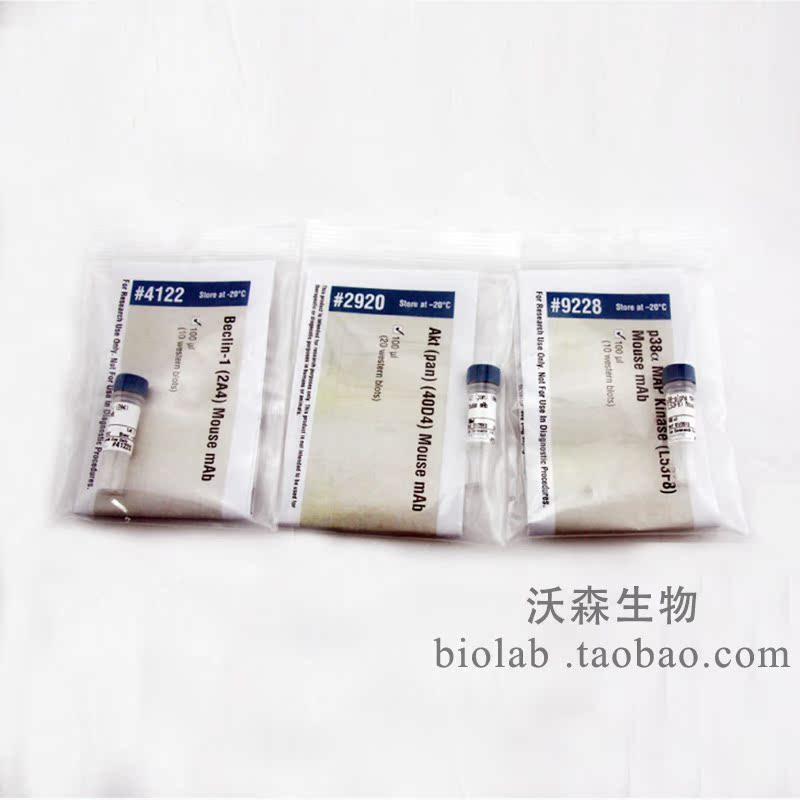
Akt (pan) (40D4) Mouse 抗體
產(chǎn)品名稱: Akt (pan) (40D4) Mouse 抗體
英文名稱: Akt (pan) (40D4) Mouse 抗體
產(chǎn)品編號(hào): mAb #2920
產(chǎn)品價(jià)格: null
產(chǎn)品產(chǎn)地: 美國(guó)
品牌商標(biāo): CST
更新時(shí)間: 2023-09-21T00:33
使用范圍:
- 聯(lián)系人 :
- 地址 : 杭州市西溪路525號(hào)浙江大學(xué)科技園B座501室
- 郵編 : 310029
- 所在區(qū)域 : 浙江
- 電話 : 137****2380 點(diǎn)擊查看
- 傳真 : 點(diǎn)擊查看
- 郵箱 : service@ws-bio.com
?
?
?

?
Akt (pan) (40D4) Mouse mAb #2920
Size
| 2920S | 100 ul ( 20 western blots ) | ? |
| 2920 | carrier free & custom formulation / quantity | ? |
Dilution
Species-Reactivity
Sensitivity
MW (kDa)
Isotype
| W | 1:2000 | Human,?Mouse,?Rat,?Monkey | Endogenous | 60 | Mouse IgG1 |
| IP | 1:50 | ||||
| IHC-P | 1:250 | ||||
| IF-IC | 1:50 | ||||
| F | 1:50 |
Species cross-reactivity is determined by western blot.
Applications Key:?W=Western Blotting,?IP=Immunoprecipitation,?IHC-P=Immunohistochemistry (Paraffin),IF-IC=Immunofluorescence (Immunocytochemistry),?F=Flow Cytometry
Specificity / Sensitivity
Akt (pan) (40D4) Mouse mAb detects endogenous levels of total Akt protein. This antibody does not cross-react with other related proteins.
Source / Purification
Monoclonal antibody is produced by immunizing animals with a synthetic peptide at the carboxy-terminal sequence of human Akt.
Western Blotting

Western blot analysis of recombinant Akt1, Akt2, Akt3 and GST proteins using Akt (pan) (40D4) Mouse mAb (upper) and GST (91G1) Rabbit mAb #2625 (lower).
Western Blotting

Western blot analysis of extracts from NIH/3T3, C6 and COS cells using Akt (pan) (40D4) Mouse mAb.
IHC-P (paraffin)

Immunohistochemical analysis of paraffin-embedded human breast carcinoma using Akt (pan) (40D4) Mouse mAb in the presence of control peptide (left) or Akt (pan) Blocking Peptide #1085 (right).
IHC-P (paraffin)

Immunohistochemical analysis using Akt (pan) (40D4) Mouse mAb on SignalSlide Phospho-Akt (Ser473) IHC Controls #8101 (paraffin-embedded LNCaP cells, untreated (left) or LY294002-treated (right)).
Flow Cytometry

Flow cytometric analysis of untreated Jurkat cells using Akt (pan) (40D4) Mouse mAb (blue) compared to a nonspecific negative control antibody (red).
IF-IC

Confocal immunofluorescent analysis of C2C12 cells, either LY294002-treated (left) or insulin-treated (right), using pan-Akt (40D4) MmAb (green). Actin filaments have been labeled with DY554 phalloidin (red). Blue pseudocolor = DRAQ5 (fluorescent DNA dye).
Background
Akt, also referred to as PKB or Rac, plays a critical role in controlling survival and apoptosis (1-3). This protein kinase is activated by insulin and various growth and survival factors to function in a wortmannin-sensitive pathway involving PI3 kinase (2,3). Akt is activated by phospholipid binding and activation loop phosphorylation at Thr308 by PDK1 (4) and by phosphorylation within the carboxy terminus at Ser473. The previously elusive PDK2 responsible for phosphorylation of Akt at Ser473 has been identified as mammalian target of rapamycin (mTOR) in a rapamycin-insensitive complex with rictor and Sin1 (5,6). Akt promotes cell survival by inhibiting apoptosis through phosphorylation and inactivation of several targets, including Bad (7), forkhead transcription factors (8), c-Raf (9), and caspase-9. PTEN phosphatase is a major negative regulator of the PI3 kinase/Akt signaling pathway (10). LY294002 is a specific PI3 kinase inhibitor (11). Another essential Akt function is the regulation of glycogen synthesis through phosphorylation and inactivation of GSK-3α and β (12,13). Akt may also play a role in insulin stimulation of glucose transport (12). In addition to its role in survival and glycogen synthesis, Akt is involved in cell cycle regulation by preventing GSK-3β-mediated phosphorylation and degradation of cyclin D1 (14) and by negatively regulating the cyclin dependent kinase inhibitors p27 Kip1 (15) and p21 Waf1/Cip1 (16). Akt also plays a critical role in cell growth by directly phosphorylating mTOR in a rapamycin-sensitive complex containing raptor (17). More importantly, Akt phosphorylates and inactivates tuberin (TSC2), an inhibitor of mTOR within the mTOR-raptor complex (18,19).
- Franke, T.F. et al. (1997)?Cell?88, 435-7.
- Burgering, B.M. and Coffer, P.J. (1995)?Nature?376, 599-602.
- Franke, T.F. et al. (1995)?Cell?81, 727-36.
- Alessi, D.R. et al. (1996)?EMBO J?15, 6541-51.
- Sarbassov, D.D. et al. (2005)?Science?307, 1098-101.
- Jacinto, E. et al. (2006)?Cell?127, 125-37.
- Cardone, M.H. et al. (1998)?Science?282, 1318-21.
- Brunet, A. et al. (1999)?Cell?96, 857-68.
- Zimmermann, S. and Moelling, K. (1999)?Science?286, 1741-4.
- Cantley, L.C. and Neel, B.G. (1999)?Proc Natl Acad Sci USA?96, 4240-5.
- Vlahos, C.J. et al. (1994)?J Biol Chem?269, 5241-8.
- Hajduch, E. et al. (2001)?FEBS Lett?492, 199-203.
- Cross, D.A. et al. (1995)?Nature?378, 785-9.
- Diehl, J.A. et al. (1998)?Genes Dev?12, 3499-511.
- Gesbert, F. et al. (2000)?J Biol Chem?275, 39223-30.
- Zhou, B.P. et al. (2001)?Nat Cell Biol?3, 245-52.
- Navé, B.T. et al. (1999)?Biochem J?344 Pt 2, 427-31.
- Inoki, K. et al. (2002)?Nat Cell Biol?4, 648-57.
- Manning, B.D. et al. (2002)?Mol Cell?10, 151-62.
Application References
- Wu, M. et al. (2009)?PLoS One?4, e6430.?Applications:?Western Blotting, IP.
- Yamada, T. et al. (2012)?Oncogene?, .?Applications:?Western Blotting.
Have?you?published research involving the use of our products? If so we'd love to hear about it. Please?let us know!
Companion Products
- 8112 ?SignalStain?Antibody Diluent
- 4691 ?Akt (pan) (C67E7) Rabbit mAb
- 4060 ?Phospho-Akt (Ser473) (D9E) XP?Rabbit mAb
- 2965 ?Phospho-Akt (Thr308) (C31E5E) Rabbit mAb
- 9916 ?Phospho-Akt Pathway Antibody Sampler Kit
- 9940 ?Akt Isoform Antibody Sampler Kit
- 2938 ?Akt1 (C73H10) Rabbit mAb
- 2964 ?Akt2 (5B5) Rabbit mAb
- 3788 ?Akt3 (62A8) Rabbit mAb
- 8101 ?SignalSlide?Phospho-Akt (Ser473) IHC Controls
- 1085 ?Akt (pan) Blocking Peptide
- 7071 ?Phototope-HRP Western Blot Detection System, Anti-rabbit IgG, HRP-linked Antibody
- 7074 ?Anti-rabbit IgG, HRP-linked Antibody
- 7720 ?Prestained Protein Marker, Broad Range (Premixed Format)
- 7727 ?Biotinylated Protein Ladder Detection Pack
- 7003 ?20X LumiGLO?Reagent and 20X Peroxide
- 8125 ?SignalStain?Boost IHC Detection Reagent (HRP, Mouse)
- For Research Use Only. Not For Use In Diagnostic Procedures.
DRAQ5?is a registered trademark of Biostatus Limited.
Cell Signaling Technology?is a trademark of Cell Signaling Technology, Inc.