
蛋白酪氨酸磷酸酶CD148抗體
產品名稱: 蛋白酪氨酸磷酸酶CD148抗體
英文名稱: DEP1
產品編號: 2567
產品價格: null
產品產地: 上海
品牌商標: 雅吉
更新時間: null
使用范圍: WB ELISA IHC-P
上海雅吉生物科技有限公司
- 聯系人 :
- 地址 : 上海市閔行區元江路5500號第1幢5658室
- 郵編 :
- 所在區域 : 上海
- 電話 : 158****3937 點擊查看
- 傳真 : 點擊查看
- 郵箱 : yajikit@163.com
?
| 中文名稱 | 蛋白酪氨酸磷酸酶CD148抗體 |
| 別????名 | CD 148; CD148; CD148 antigen; Density enhanced phosphatase 1; Density-enhanced phosphatase 1; DEP 1; DEP-1; HPTP eta; HPTPeta; Human density enhanced phosphatase 1; Protein tyrosine phosphatase eta; Protein tyrosine phosphatase receptor type J; Protein tyrosine phosphatase receptor type J polypeptide; Protein-tyrosine phosphatase eta; Protein-tyrosine phosphatase receptor type J; PTPJ; Ptprj; PTPRJ_HUMAN; R PTP Eta; R-PTP-eta; R-PTP-J; Receptor type tyrosine protein phosphatase eta; Receptor-type tyrosine-protein phosphatase eta; SCC 1; SCC1.?? |
| 研究領域 | 細胞生物??信號轉導??激酶和磷酸酶?? |
| 抗體來源 | Rabbit |
| 克隆類型 | Polyclonal |
| 交叉反應 | Human,?Mouse,? (predicted: Rat,?Rabbit,?) |
| 產品應用 | WB=1:500-2000?ELISA=1:500-1000?IHC-P=1:100-500?(石蠟切片需做抗原修復) not yet tested in other applications. optimal dilutions/concentrations should be determined by the end user. |
| 分?子?量 | 147kDa |
| 細胞定位 | 細胞膜? |
| 性????狀 | Liquid |
| 濃????度 | 1mg/ml |
| 免?疫?原 | KLH conjugated synthetic peptide derived from human PTPRJ:865-970/1337? |
| 亞????型 | IgG |
| 純化方法 | affinity purified by Protein A |
| 儲?存?液 | 0.01M TBS(pH7.4) with 1% BSA, 0.03% Proclin300 and 50% Glycerol. |
| 保存條件 | Shipped at 4℃. Store at -20 °C for one year. Avoid repeated freeze/thaw cycles. |
| PubMed | PubMed |
| 產品介紹 | The protein encoded by this gene is a member of the protein tyrosine phosphatase (PTP) family. PTPs are known to be signaling molecules that regulate a variety of cellular processes, including cell growth, differentiation, mitotic cycle, and oncogenic transformation. This PTP possesses an extracellular region containing five fibronectin type III repeats, a single transmembrane region, and a single intracytoplasmic catalytic domain, and thus represents a receptor-type PTP. This protein is present in all hematopoietic lineages, and was shown to negatively regulate T cell receptor signaling possibly through interfering with the phosphorylation of Phospholipase C Gamma 1 and Linker for Activation of T Cells. This protein can also dephosphorylate the PDGF beta receptor, and may be involved in UV-induced signal transduction. Multiple transcript variants encoding different isoforms have been found for this gene. [provided by RefSeq]. Function: Tyrosine phosphatase which dephosphorylates or contributes to the dephosphorylation of CTNND1, FLT3, PDGFRB, MET, RET (variant MEN2A), KDR, LYN, SRC, MAPK1, MAPK3, EGFR, TJP1, OCLN, PIK3R1 and PIK3R2. Plays a role in cell adhesion, migration, proliferation and differentiation. Involved in vascular development. Regulator of macrophage adhesion and spreading. Positively affects cell-matrix adhesion. Positive regulator of platelet activation and thrombosis. Negative regulator of cell proliferation. Negative regulator of PDGF-stimulated cell migration; through dephosphorylation of PDGFR. Positive regulator of endothelial cell survival, as well as of VEGF-induced SRC and AKT activation; through KDR dephosphorylation. Negative regulator of EGFR signaling pathway; through EGFR dephosphorylation. Enhances the barrier function of epithelial junctions during reassembly. Negatively regulates T-cell receptor (TCR) signaling. Upon T-cell TCR activation, it is up-regulated and excluded from the immunological synapses, while upon T-cell-antigen presenting cells (APC) disengagement, it is no longer excluded and can dephosphorylate PLCG1 and LAT to down-regulate prolongation of signaling. Subunit: Monomer. Interacts with CTNNB1 (phosphorylated) and JUP (phosphorylated). Interacts with FLT3 (phosphorylated). Interacts with GAB1 and GRB2. Subcellular Location: Cell membrane. Tissue Specificity: Expressed in the promyelocytic cell line HL60, the granulocyte-macrophage colony-stimulating factor-dependent leukemic cell line F-36P, and the interleukin-3 and erythropoietin-dependent leukemic cell line F-36E. Expressed predominantly in epithelial cells and lymphocytes. Enhanced expression at high cell density. Post-translational modifications: N- and O-glycosylated. Similarity: Belongs to the protein-tyrosine phosphatase family. Receptor class 3 subfamily. Contains 9 fibronectin type-III domains. Contains 1 tyrosine-protein phosphatase domain. SWISS: Q12913 Gene ID: 5795 Database links: Entrez Gene: 5795?Human Omim: 600925?Human SwissProt: Q12913?Human Unigene: 318547?Human Important Note: This product as supplied is intended for research use only, not for use in human, therapeutic or diagnostic applications. ? |
| 產品圖片 | 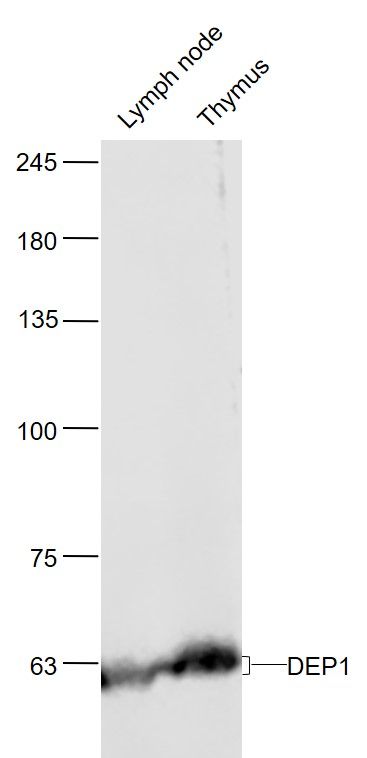 Sample: Sample:Lymph node (Mouse) Lysate at 40 ug Thymus (Mouse) Lysate at 40 ug Primary: Anti-DEP1 (bs-2567R) at 1/1000 dilution Secondary: IRDye800CW Goat Anti-Rabbit IgG at 1/20000 dilution Predicted band size: 60'100 kD Observed band size: 60 kD 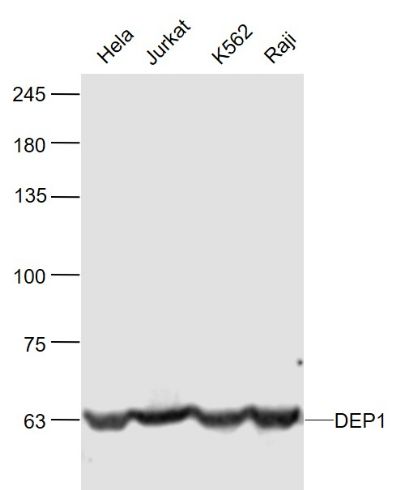 Sample: Sample:Hela(Human) Cell Lysate at 30 ug Jurkat(Human) Cell Lysate at 30 ug K562(Human) Cell Lysate at 30 ug Raji(Human) Cell Lysate at 30 ug Primary: Anti-DEP1 (bs-2567R) at 1/1000 dilution Secondary: IRDye800CW Goat Anti-Rabbit IgG at 1/20000 dilution Predicted band size: 60'100 kD Observed band size: 60 kD 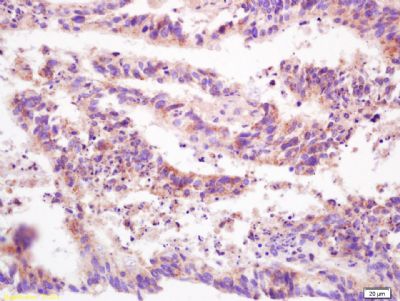 Tissue/cell: human colon carcinoma; 4% Paraformaldehyde-fixed and paraffin-embedded; Tissue/cell: human colon carcinoma; 4% Paraformaldehyde-fixed and paraffin-embedded;Antigen retrieval: citrate buffer ( 0.01M, pH 6.0 ), Boiling bathing for 15min; Block endogenous peroxidase by 3% Hydrogen peroxide for 30min; Blocking buffer (normal goat serum,C-0005) at 37℃ for 20 min; Incubation: Anti-PTP/PTPase/CD148 Polyclonal Antibody, Unconjugated(bs-2567R) 1:200, overnight at 4°C, followed by conjugation to the secondary antibody(SP-0023) and DAB(C-0010) staining 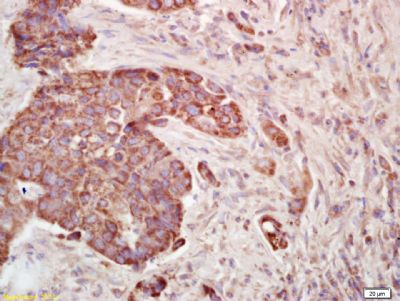 Tissue/cell: human lung carcinoma; 4% Paraformaldehyde-fixed and paraffin-embedded; Tissue/cell: human lung carcinoma; 4% Paraformaldehyde-fixed and paraffin-embedded;Antigen retrieval: citrate buffer ( 0.01M, pH 6.0 ), Boiling bathing for 15min; Block endogenous peroxidase by 3% Hydrogen peroxide for 30min; Blocking buffer (normal goat serum,C-0005) at 37℃ for 20 min; Incubation: Anti-PTP/PTPase/CD148 Polyclonal Antibody, Unconjugated(bs-2567R) 1:200, overnight at 4°C, followed by conjugation to the secondary antibody(SP-0023) and DAB(C-0010) staining |
?