信號轉導和轉錄激活因子3單克隆抗體
產品名稱: 信號轉導和轉錄激活因子3單克隆抗體
英文名稱: STAT3
產品編號: 3218M
產品價格: null
產品產地: 上海
品牌商標: 雅吉
更新時間: null
使用范圍: WB, IF, ICC
上海雅吉生物科技有限公司
- 聯系人 :
- 地址 : 上海市閔行區元江路5500號第1幢5658室
- 郵編 :
- 所在區域 : 上海
- 電話 : 158****3937 點擊查看
- 傳真 : 點擊查看
- 郵箱 : yajikit@163.com
?英文名稱STAT3中文名稱信號轉導和轉錄激活因子3單克隆抗體別? ? 名1110034C02Rik; Acute Phase Response Factor; APRF; AW109958; DNA binding protein APRF; FLJ20882; HIES; MGC128731; MGC16063; MGC93551; Signal transducer and activator of transcription 3 (acute-phase response factor); Signal transducer and activator of transcription 3; Signal Transductor and Activator of Transcription 3; STAT 3; Transcription factor; STAT3_HUMAN.?研究領域腫瘤? 細胞生物? 信號轉導? 細胞凋亡? 轉錄調節因子??抗體來源Mouse克隆類型Monoclonal克 隆 號3F5交叉反應Human, Mouse, Rat,?產品應用WB=1:500-1000 IHC-P=1:100-500 IHC-F=1:100-500 ICC=1:100-500 IF=1:100-500 (石蠟切片需做抗原修復)not yet tested in other applications.optimal dilutions/concentrations should be determined by the end user.分 子 量88kDa細胞定位細胞核 細胞漿?性? ? 狀Liquid濃? ? 度1mg/ml免 疫 原Recombinant human STAT3 Protein:9-265/770?亞? ? 型IgG純化方法affinity purified by Protein G儲 存 液0.01M TBS(pH7.4) with 1% BSA, 0.03% Proclin300 and 50% Glycerol.保存條件Shipped at 4℃. Store at -20 °C for one year. Avoid repeated freeze/thaw cycles.PubMedPubMed產品介紹The protein encoded by this gene is a member of the STAT protein family. In response to cytokines and growth factors, STAT family members are phosphorylated by the receptor associated kinases, and then form homo- or heterodimers that translocate to the cell nucleus where they act as transcription activators. This protein is activated through phosphorylation in response to various cytokines and growth factors including IFNs, EGF, IL5, IL6, HGF, LIF and BMP2. This protein mediates the expression of a variety of genes in response to cell stimuli, and thus plays a key role in many cellular processes such as cell growth and apoptosis. The small GTPase Rac1 has been shown to bind and regulate the activity of this protein. PIAS3 protein is a specific inhibitor of this protein. Three alternatively spliced transcript variants encoding distinct isoforms have been described. Gene Symbol: APRF; FLJ20882; HIES; MGC16063.?Subunit:Forms a homodimer or a heterodimer with a related family member (at least STAT1). Interacts with IL31RA, NCOA1, PELP1, SIPAR, SOCS7, STATIP1 and TMF1. Interacts with HCV core protein. Interacts with IL23R in presence of IL23. Interacts (via SH2 domain) with NLK. Interacts with ARL2BP; the interaction is enhanced by LIF and JAK1 expression (By similarity). Interacts with KPNA4 and KPNA5; KPNA4 may be the primary mediator of nuclear import (By similarity). Interacts with CAV2; the interaction is increased on insulin-induced tyrosine phosphorylation of CAV2 and leads to STAT3 activation (By similarity). Interacts with ARL2BP; interaction is enhanced with ARL2. Interacts with NEK6 (By similarity). Binds to CDK9 when activated and nuclear. Interacts with BMX. Interacts with ZIPK/DAPK3. Interacts with PIAS3; the interaction occurs on stimulation by IL6, CNTF or OSM and inhibits the DNA binding activity of STAT3. In prostate cancer cells, interacts with STAT3 and promotes DNA binding activity of STAT3. Interacts with STMN3, antagonizing its microtubule-destabilizing activity.?Subcellular Location:Cytoplasm. Nucleus. Note=Shuttles between the nucleus and the cytoplasm. Translocated into the nucleus upon tyrosine phosphorylation and dimerization, in response to signaling by activated FGFR1, FGFR2, FGFR3 or FGFR4. Constitutive nuclear presence is independent of tyrosine phosphorylation. Predominantly present in the cytoplasm without stimuli. Upon leukemia inhibitory factor (LIF) stimulation, accumulates in the nucleus. The complex composed of BART and ARL2 plays an important role in the nuclear translocation and retention of STAT3. Identified in a complex with LYN and PAG1.?Tissue Specificity:Heart, brain, placenta, lung, liver, skeletal muscle, kidney and pancreas.?Similarity:Belongs to the transcription factor STAT family.Contains 1 SH2 domain.?SWISS:P40763?Gene ID:6774?Database links:Entrez Gene: 6774 Human?Entrez Gene: 20848 Mouse?Entrez Gene: 25125 Rat?Omim: 102582 Human?SwissProt: P40763 Human?SwissProt: P42227 Mouse?SwissProt: P52631 Rat?Unigene: 463059 Human???Important Note:This product as supplied is intended for research use only, not for use in human, therapeutic or diagnostic applications.?Stat3在細胞分化、增殖、凋亡等方面有著重要生理作用。有學者認為:STAT-3對腫瘤有一定的抑制作用,由于其與腫瘤的關系較為密切,越來越受到人們的重視。
產品圖片
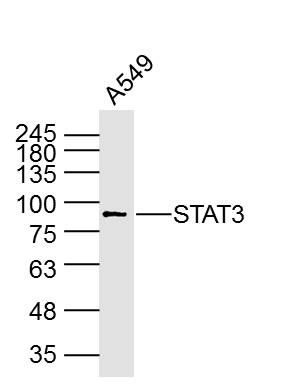
Primary: Anti-STAT3 (bsm-33218M) at 1/1000 dilution
Secondary: IRDye800CW Goat Anti-Mouse IgG at 1/20000 dilution
Predicted band size: 88 kD
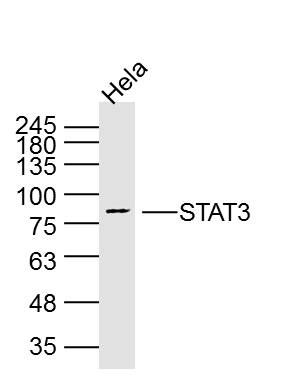
Observed band size: 88 kDSample: Hela Cell (Human) Lysate at 40 ug
Primary: Anti-STAT3 (bsm-33218M) at 1/1000 dilution
Secondary: IRDye800CW Goat Anti-Mouse IgG at 1/20000 dilution
Predicted band size: 88 kD
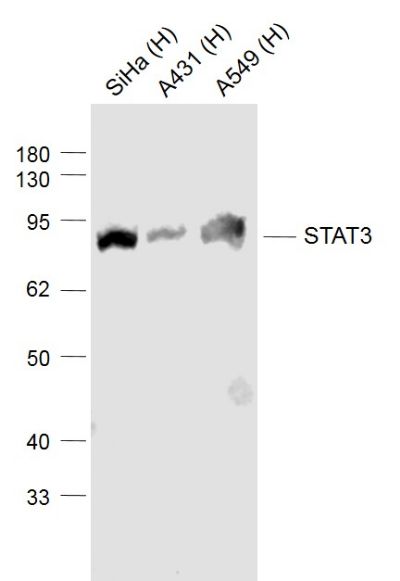
Observed band size: 88 kDSample:
Lane 1: SiHa (Human) Cell Lysate at 30 ug
Lane 2: A431 (Human) Cell Lysate at 30 ug
Lane 3: A549 (Human) Cell Lysate at 30 ug
Primary: Anti-STAT3 (bsm-33218M) at 1/1000 dilution
Secondary: IRDye800CW Goat Anti-Mouse IgG at 1/20000 dilution
Predicted band size: 88 kD
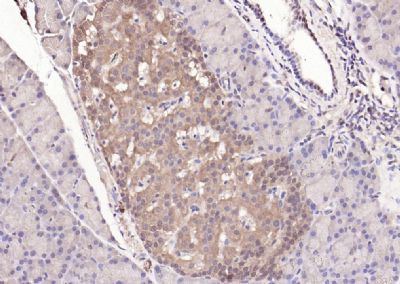
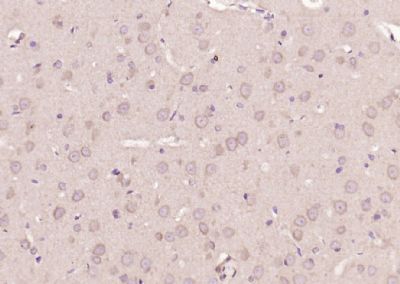
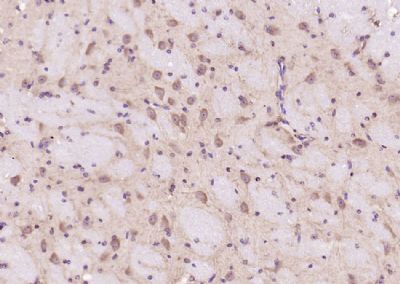
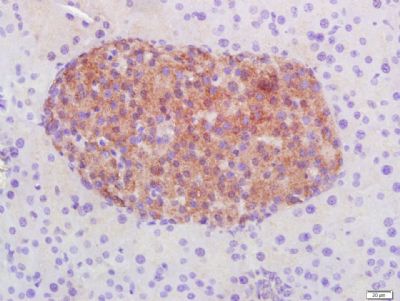
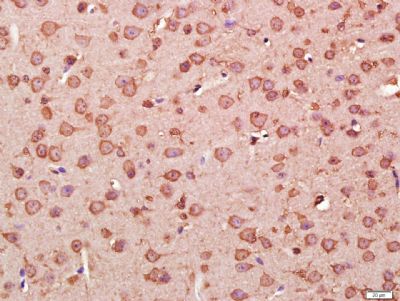
Observed band size: 88 kDParaformaldehyde-fixed, paraffin embedded (rat pancreas); Antigen retrieval by boiling in sodium citrate buffer (pH6.0) for 15min; Block endogenous peroxidase by 3% hydrogen peroxide for 20 minutes; Blocking buffer (normal goat serum) at 37°C for 30min; Antibody incubation with (STAT3) Polyclonal Antibody, Unconjugated (bsm-33218M) at 1:200 overnight at 4°C, followed by operating according to SP Kit(Mouse)(sp-0024) instructionsand DAB staining.Paraformaldehyde-fixed, paraffin embedded (rat brain); Antigen retrieval by boiling in sodium citrate buffer (pH6.0) for 15min; Block endogenous peroxidase by 3% hydrogen peroxide for 20 minutes; Blocking buffer (normal goat serum) at 37°C for 30min; Antibody incubation with (STAT3) Polyclonal Antibody, Unconjugated (bsm-33218M) at 1:200 overnight at 4°C, followed by operating according to SP Kit(Mouse)(sp-0024) instructionsand DAB staining.Paraformaldehyde-fixed, paraffin embedded (mouse brain); Antigen retrieval by boiling in sodium citrate buffer (pH6.0) for 15min; Block endogenous peroxidase by 3% hydrogen peroxide for 20 minutes; Blocking buffer (normal goat serum) at 37°C for 30min; Antibody incubation with (STAT3) Polyclonal Antibody, Unconjugated (bsm-33218M) at 1:200 overnight at 4°C, followed by operating according to SP Kit(Mouse)(sp-0024) instructionsand DAB staining.Paraformaldehyde-fixed, paraffin embedded (Mouse pancreas); Antigen retrieval by boiling in sodium citrate buffer (pH6.0) for 15min; Block endogenous peroxidase by 3% hydrogen peroxide for 20 minutes; Blocking buffer (normal goat serum) at 37°C for 30min; Antibody incubation with (STAT3) Monoclonal Antibody, Unconjugated (bsm-33218M) at 1:400 overnight at 4°C, followed by a conjugated secondary (sp-0023) for 20 minutes and DAB staining.Paraformaldehyde-fixed, paraffin embedded (Mouse brain); Antigen retrieval by boiling in sodium citrate buffer (pH6.0) for 15min; Block endogenous peroxidase by 3% hydrogen peroxide for 20 minutes; Blocking buffer (normal goat serum) at 37°C for 30min; Antibody incubation with (STAT3) Monoclonal Antibody, Unconjugated (bsm-33218M) at 1:400 overnight at 4°C, followed by a conjugated secondary (sp-0023) for 20 minutes and DAB staining.
? ?