
SimpleChIP® 酶解染色質(zhì)免疫沉淀試劑盒
產(chǎn)品名稱: SimpleChIP® 酶解染色質(zhì)免疫沉淀試劑盒
英文名稱: SimpleChIP® Enzymatic Chromatin IP Kit (Agarose Beads
產(chǎn)品編號(hào): 9002/9003
產(chǎn)品價(jià)格: null
產(chǎn)品產(chǎn)地: 美國(guó)
品牌商標(biāo): CST
更新時(shí)間: null
使用范圍:
- 聯(lián)系人 :
- 地址 : 深圳市寶安區(qū)西鄉(xiāng)寶民二路賢基大廈4E
- 郵編 :
- 所在區(qū)域 : 廣東
- 電話 : 133****4454 點(diǎn)擊查看
- 傳真 : 點(diǎn)擊查看
- 郵箱 : 1484332550@qq.com
CST的SimpleChIP? 酶解染色質(zhì)免疫沉淀試劑盒是由CST與New England Biolabs的科學(xué)家聯(lián)合開發(fā)的,因此包含了最高質(zhì)量的研究試劑。該試劑盒有兩種:Protein G 瓊脂糖微球和Protein G 磁珠,所包含的緩沖液和試劑足夠做30次ChIP實(shí)驗(yàn)。Protein G 瓊脂微球和Protein G 磁珠也有單獨(dú)的產(chǎn)品。
酶消化染色質(zhì)比超聲破碎更加溫和。溫和的處理方式更好保留了染色質(zhì)完整性和蛋白的抗原表位, 增加了免疫沉淀的效率。
詳細(xì)的操作步驟專為細(xì)胞和組織樣品優(yōu)化,節(jié)約您的時(shí)間和試劑。
試劑盒可與任何ChIP級(jí)抗體一起檢測(cè)哺乳動(dòng)物細(xì)胞內(nèi)源水平的蛋白質(zhì)-DNA相互作用和組蛋白修飾。
包含所有試劑和對(duì)照,節(jié)約時(shí)間,提供合適的實(shí)驗(yàn)對(duì)照。
試劑盒內(nèi)的試劑在公司內(nèi)部用于驗(yàn)證我們的ChIP 抗體,將方便您的優(yōu)化。
試劑盒內(nèi)包含的ChIP 級(jí)磁珠非常適于下游的ChIP-on-chip 或 ChIP 測(cè)序,因?yàn)槠涓叩撵`敏度和低背景。
9002?????? SimpleChIP? Enzymatic Chromatin IP Kit (Agarose Beads)????
?
9003?????? SimpleChIP? Enzymatic Chromatin IP Kit (Magnetic Beads)
SimpleChIP? Enzymatic Chromatin IP Kit (Agarose Beads)包含緩沖液和試劑,必須進(jìn)行6次染色質(zhì)準(zhǔn)備和30次染色質(zhì)免疫沉淀,并且每次實(shí)驗(yàn)最佳的細(xì)胞數(shù)為4 X 10⁷ 。一個(gè)完整的實(shí)驗(yàn)至少兩天時(shí)間被完成,并且對(duì)于使用多的或少的細(xì)胞數(shù)試劑盒很容易擴(kuò)大或縮小。細(xì)胞使用甲醛固定,并且通過微球菌核酸酶部分程度上酶切染色質(zhì)成片段,從而獲得1-5個(gè)核小體的染色質(zhì)片段。染色質(zhì)的酶切片段是比超聲更加溫和以及消除了由超聲功率的可比性以及在超聲講解中染色質(zhì)的乳化作用帶來的問題,這能夠?qū)е氯旧|(zhì)的不完全片段化或由于蛋白質(zhì)變性和降解造成的抗體表位的損失。使用ChIP-validated antibodies和ChIP-Grade Protein G Agarose Beads進(jìn)行染色質(zhì)免疫沉淀。在蛋白質(zhì)-DNA交聯(lián)的逆轉(zhuǎn)之后,使用DNA純化旋轉(zhuǎn)柱被純化,這允許DNA更容易和高效的恢復(fù),并且蛋白質(zhì)的移除不需要苯酚/氯仿的提取和乙醇的沉淀。在免疫沉淀中特定的DNA序列的濃縮能夠通過standard PCR、quantitative real-time PCR或 ChIP on chip、sequencing 和cloning techniques的擴(kuò)增被分析。SimpleChIP? Kit也提供重要的對(duì)照去保證一個(gè)成功的ChIP實(shí)驗(yàn)。該試劑盒包含一個(gè)陽性對(duì)照Histone H3 Antibody、一個(gè)陰性對(duì)照Normal Rabbit IgG Antibody和用于PCR的人源和小鼠ribosomal protein L30 (RPL30)基因引物對(duì)。Histone H3是一個(gè)染色質(zhì)中心部分,并且穿過基因組結(jié)合到許多DNA序列上,包括RPL30位點(diǎn)。因此,Histone H3 Antibody 提供一個(gè)普遍的陽性對(duì)照,對(duì)于任何位點(diǎn)檢測(cè)都應(yīng)該比較豐富。
?
Gel Staining
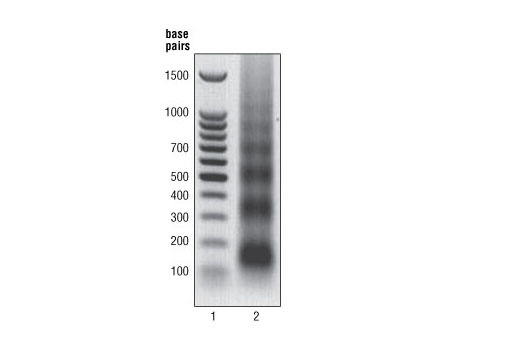
FIGURE 1. HeLa cells were formaldehyde-crosslinked and chromatin was prepared and digested as described in Section A of protocol. DNA was purified as described in Section B and 10 μl were separated by electrophoresis on a 1% agarose gel (lane 2) and stained with ethidium bromide. Lane 2 shows that the majority of chromatin was digested to 1 to 5 nucleosomes in length (150 to 900 bp).
Chromatin IP
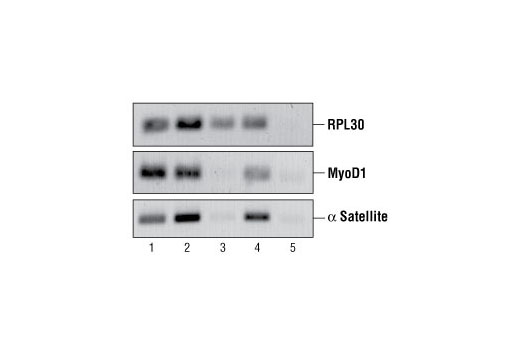
FIGURE 3. Chromatin immunoprecipitations were performed using digested chromatin from HeLa cells and the indicated ChIP-validated antibodies. Purified DNA was analyzed by quantitative real-time PCR, using SimpleChIP? Human RPL30 Exon 3 Primers #7014 (control primer set), SimpleChIP? Human MyoD1 Exon 1 Primers #4490, and SimpleChIP? Human α Satellite Repeat Primers #4486. The amount of immunoprecipitated DNA in each sample is represented as signal relative to the total amount of input chromatin (equivalent to 1).
圖3:使用來自HeLa細(xì)胞消化的染色質(zhì)和指明的ChIP-validated antibodies進(jìn)行染色質(zhì)免疫沉淀。使用 SimpleChIP? Human RPL30 Exon 3 Primers #7014 (control primer set)、SimpleChIP? Human MyoD1 Exon 1 Primers #4490和SimpleChIP? Human α Satellite Repeat Primers #4486,通過quantitative real-time PCR分析純化的DNA。在每個(gè)樣品中免疫沉淀的DNA數(shù)量被看作與input chromatin (相當(dāng)于1)相關(guān)的信號(hào)。
?
Chromatin IP

FIGURE 3. Chromatin immunoprecipitations were performed using digested chromatin from HeLa cells and the indicated ChIP-validated antibodies. Purified DNA was analyzed by quantitative real-time PCR, using SimpleChIP? Human RPL30 Exon 3 Primers #7014 (control primer set), SimpleChIP? Human MyoD1 Exon 1 Primers #4490, and SimpleChIP? Human α Satellite Repeat Primers #4486. The amount of immunoprecipitated DNA in each sample is represented as signal relative to the total amount of input chromatin (equivalent to 1).
圖3:使用來自HeLa細(xì)胞消化的染色質(zhì)和指明的ChIP-validated antibodies進(jìn)行染色質(zhì)免疫沉淀。使用 SimpleChIP? Human RPL30 Exon 3 Primers #7014 (control primer set)、SimpleChIP? Human MyoD1 Exon 1 Primers #4490和SimpleChIP? Human α Satellite Repeat Primers #4486,通過quantitative real-time PCR分析純化的DNA。在每個(gè)樣品中免疫沉淀的DNA數(shù)量被看作與input chromatin (相當(dāng)于1)相關(guān)的信號(hào)。
?
Background
The chromatin immunoprecipitation (ChIP) assay is a powerful and versatile technique used for probing protein-DNA interactions within the natural chromatin context of the cell (1,2). This assay can be used to identify multiple proteins associated with a specific region of the genome, or the opposite, to identify the many regions of the genome bound by a particular protein (3-6). It can be used to determine the specific order of recruitment of various proteins to a gene promoter or to "measure" the relative amount of a particular histone modification across an entire gene locus (3,4). In addition to histone proteins, the ChIP assay can be used to analyze binding of transcription factors and co-factors, DNA replication factors and DNA repair proteins. ? When performing the ChIP assay, cells or tissues are first fixed with formaldehyde, a reversible protein-DNA cross-linking agent that "preserves" the protein-DNA interactions occurring in the cell (1,2). Cells are lysed and chromatin is harvested and fragmented using either sonication or enzymatic digestion. The chromatin is then immunoprecipitated with antibodies specific to a particular protein or histone modification. Any DNA sequences that are associated with the protein or histone modification of interest will co-precipitate as part of the cross-linked chromatin complex and the relative amount of that DNA sequence will be enriched by the immunoselection process. After immunoprecipitation, the protein-DNA cross-links are reversed and the DNA is purified. Standard PCR or Quantitative Real-Time PCR can be used to measure the amount of enrichment of a particular DNA sequence by a protein-specific immunoprecipitation (1,2). Alternatively, the ChIP assay can be combined with genomic tiling micro-array (ChIP on chip) techniques, high throughput sequencing, or cloning strategies, all of which allow for genome-wide analysis of protein-DNA interactions and histone modifications (5-8).
?
chromatin immunoprecipitation (ChIP)實(shí)驗(yàn)室一個(gè)強(qiáng)大的和通用的技術(shù),它用于檢測(cè)在細(xì)胞的天然染色質(zhì)中蛋白質(zhì)-DNA的相互作用(1,2)。該分析通常被用于鑒定與一個(gè)基因組的特異區(qū)域或?qū)α⒚嬗嘘P(guān)的多種蛋白質(zhì),或者去鑒定基因組的許多一個(gè)特定蛋白結(jié)合區(qū)域(3-6)。它可以用來確定不同蛋白質(zhì)的特異性招募到一個(gè)基因的啟動(dòng)子或去測(cè)量在整個(gè)基因上一個(gè)特定組蛋白修飾的相對(duì)數(shù)量(3,4)。除了組蛋白之外,ChIP實(shí)驗(yàn)通常用來分析轉(zhuǎn)錄因子的結(jié)合和輔助因子、DNA復(fù)制因子和DNA修復(fù)蛋白。當(dāng)進(jìn)行ChIP實(shí)驗(yàn)時(shí),細(xì)胞或組織首先用甲醛固定,甲醛是一個(gè)可逆的蛋白質(zhì)-DNA交聯(lián)試劑,它可保留細(xì)胞中蛋白質(zhì)-DNA相互作用事件(1,2)。細(xì)胞被裂解以及染色質(zhì)被收獲,并且使用聲波降解法或酶促消化去分裂染色質(zhì)。然后,使用特異性的特定蛋白質(zhì)或組蛋白修飾的抗體進(jìn)行免疫沉淀染色質(zhì)。任何DNA序列都與蛋白質(zhì)相關(guān)或者感興趣的組蛋白修飾將與交聯(lián)染色質(zhì)的部分共沉淀,以及通過免疫選擇過程DNA序列的相對(duì)數(shù)量可以被豐富。在免疫沉淀之后,蛋白質(zhì)-DNA交聯(lián)是可逆的,以及DNA被純化。Standard PCR或Quantitative Real-Time PCR通常用于檢測(cè)通過一個(gè)蛋白質(zhì)特異的免疫沉淀的DNA序列相對(duì)數(shù)量(1,2)。二者擇一地,ChIP分析能夠結(jié)合 genomic tiling micro-array (ChIP on chip)技術(shù)、高通量測(cè)序或克隆,所有這些都能進(jìn)行蛋白質(zhì)-DNA相互作用的全基因組分析和組蛋白修飾