甲基化組蛋白H3(di methyl K27)單克隆抗體
產品名稱: 甲基化組蛋白H3(di methyl K27)單克隆抗體
英文名稱: Histone H3(di methyl K27)
產品編號: 33107M
產品價格: null
產品產地: 上海
品牌商標: 雅吉
更新時間: null
使用范圍: WB, IF, ICC
上海雅吉生物科技有限公司
- 聯系人 :
- 地址 : 上海市閔行區元江路5500號第1幢5658室
- 郵編 :
- 所在區域 : 上海
- 電話 : 158****3937 點擊查看
- 傳真 : 點擊查看
- 郵箱 : yajikit@163.com
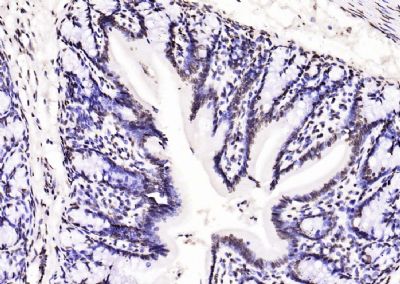
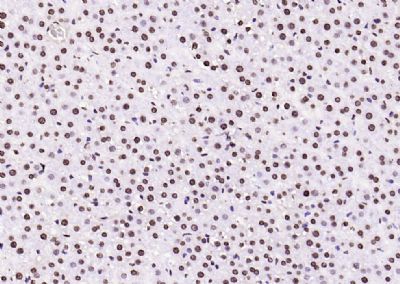
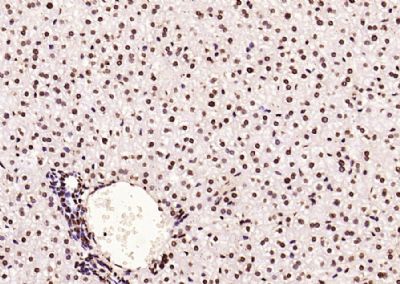
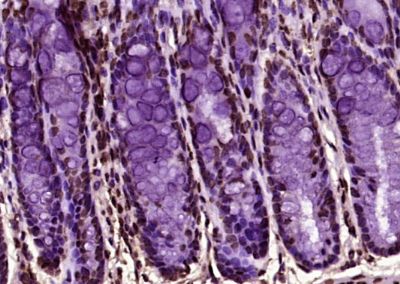
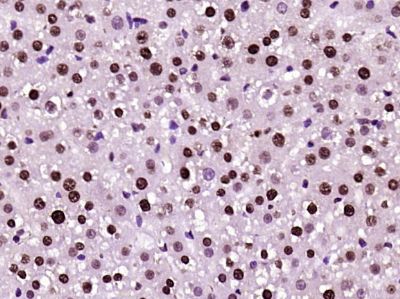
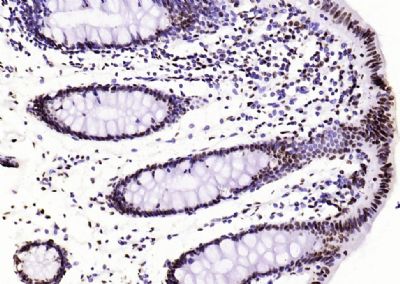
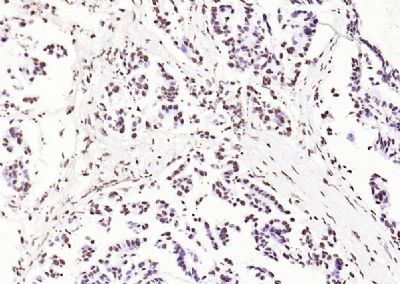
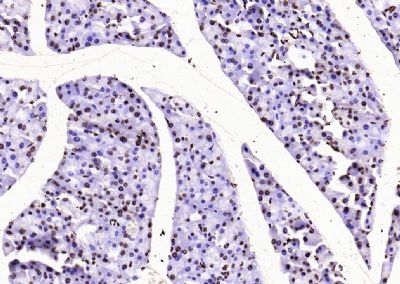
英文名稱Histone H3(di methyl K27)中文名稱甲基化組蛋白H3(di methyl K27)單克隆抗體別? ? 名Histone Cluster 3, H3; H3 Histone Family, Member T; Histone 3, H3; H3FT; H3/G; H3/T; H3t; H3.4 ; Histone H3.1t ; HIST3H3; HGNC:4778; H31T_HUMAN??產品類型甲基化抗體?研究領域染色質和核信號? 表觀遺傳學??抗體來源Mouse克隆類型Monoclonal克 隆 號5C11交叉反應Human, Mouse, Rat,?產品應用WB=1:500-2000 ELISA=1:500-1000 IHC-P=1:100-500 IHC-F=1:100-500 ICC=1:100-500 IF=1:100-500 (石蠟切片需做抗原修復)not yet tested in other applications.optimal dilutions/concentrations should be determined by the end user.分 子 量15kDa細胞定位細胞核?性? ? 狀Liquid濃? ? 度1mg/ml免 疫 原KLH conjugated synthesised methylpeptide derived from human Histone H3 around the methylation site of di methyl K27:AR(di Methyl-K)SA?亞? ? 型IgG1純化方法affinity purified by Protein G儲 存 液0.01M TBS(pH7.4) with 1% BSA, 0.03% Proclin300 and 50% Glycerol.保存條件Shipped at 4℃. Store at -20 °C for one year. Avoid repeated freeze/thaw cycles.PubMedPubMed產品介紹Histones are basic nuclear proteins that are responsible for the nucleosome structure of the chromosomal fiber in eukaryotes. Nucleosomes consist of approximately 146 bp of DNA wrapped around a histone octamer composed of pairs of each of the four core histones (H2A, H2B, H3, and H4). The chromatin fiber is further compacted through the interaction of a linker histone, H1, with the DNA between the nucleosomes to form higher order chromatin structures. This gene is intronless and encodes a replication-dependent histone that is a member of the histone H3 family. Transcripts from this gene lack polyA tails; instead, they contain a palindromic termination element. This gene is located separately from the other H3 genes that are in the histone gene cluster on chromosome 6p22-p21.3. [provided by RefSeq, Aug 2015]?Function:Core component of nucleosome. Nucleosomes wrap and compact DNA into chromatin, limiting DNA accessibility to the cellular machineries which require DNA as a template. Histones thereby play a central role in transcription regulation, DNA repair, DNA replication and chromosomal stability. DNA accessibility is regulated via a complex set of post-translational modifications of histones, also called histone code, and nucleosome remodeling.?Subunit:The nucleosome is a histone octamer containing two molecules each of H2A, H2B, H3 and H4 assembled in one H3-H4 heterotetramer and two H2A-H2B heterodimers. The octamer wraps approximately 147 bp of DNA.?Subcellular Location:Nucleus; Chromosome?Tissue Specificity:Expressed in testicular cells.Expressed during S phase, then expression strongly decreases as cell division slows down during the process of differentiation.?Post-translational modifications:Acetylation is generally linked to gene activation. Acetylation on Lys-10 (H3K9ac) impairs methylation at Arg-9 (H3R8me2s). Acetylation on Lys-19 (H3K18ac) and Lys-24 (H3K24ac) favors methylation at Arg-18 (H3R17me). Acetylation at Lys-123 (H3K122ac) by EP300/p300 plays a central role in chromatin structure: localizes at the surface of the histone octamer and stimulates transcription, possibly by promoting nucleosome instability (By similarity).Citrullination at Arg-9 (H3R8ci) and/or Arg-18 (H3R17ci) by PADI4 impairs methylation and represses transcription.Asymmetric dimethylation at Arg-18 (H3R17me2a) by CARM1 is linked to gene activation. Symmetric dimethylation at Arg-9 (H3R8me2s) by PRMT5 is linked to gene repression. Asymmetric dimethylation at Arg-3 (H3R2me2a) by PRMT6 is linked to gene repression and is mutually exclusive with H3 Lys-5 methylation (H3K4me2 and H3K4me3). H3R2me2a is present at the 3' of genes regardless of their transcription state and is enriched on inactive promoters, while it is absent on active promoters (By similarity).Methylation at Lys-5 (H3K4me), Lys-37 (H3K36me) and Lys-80 (H3K79me) are linked to gene activation. Methylation at Lys-5 (H3K4me) facilitates subsequent acetylation of H3 and H4. Methylation at Lys-80 (H3K79me) is associated with DNA double-strand break (DSB) responses and is a specific target for TP53BP1. Methylation at Lys-10 (H3K9me) and Lys-28 (H3K27me) are linked to gene repression. Methylation at Lys-10 (H3K9me) is a specific target for HP1 proteins (CBX1, CBX3 and CBX5) and prevents subsequent phosphorylation at Ser-11 (H3S10ph) and acetylation of H3 and H4. Methylation at Lys-5 (H3K4me) and Lys-80 (H3K79me) require preliminary monoubiquitination of H2B at 'Lys-120'. Methylation at Lys-10 (H3K9me) and Lys-28 (H3K27me) are enriched in inactive X chromosome chromatin. Monomethylation at Lys-57 (H3K56me1) by EHMT2/G9A in G1 phase promotes interaction with PCNA and is required for DNA replication (By similarity).Phosphorylated at Thr-4 (H3T3ph) by GSG2/haspin during prophase and dephosphorylated during anaphase. Phosphorylation at Ser-11 (H3S10ph) by AURKB is crucial for chromosome condensation and cell-cycle progression during mitosis and meiosis. In addition phosphorylation at Ser-11 (H3S10ph) by RPS6KA4 and RPS6KA5 is important during interphase because it enables the transcription of genes following external stimulation, like mitogens, stress, growth factors or UV irradiation and result in the activation of genes, such as c-fos and c-jun. Phosphorylation at Ser-11 (H3S10ph), which is linked to gene activation, prevents methylation at Lys-10 (H3K9me) but facilitates acetylation of H3 and H4. Phosphorylation at Ser-11 (H3S10ph) by AURKB mediates the dissociation of HP1 proteins (CBX1, CBX3 and CBX5) from heterochromatin. Phosphorylation at Ser-11 (H3S10ph) is also an essential regulatory mechanism for neoplastic cell transformation. Phosphorylated at Ser-29 (H3S28ph) by MLTK isoform 1, RPS6KA5 or AURKB during mitosis or upon ultraviolet B irradiation. Phosphorylation at Thr-7 (H3T6ph) by PRKCB is a specific tag for epigenetic transcriptional activation that prevents demethylation of Lys-5 (H3K4me) by LSD1/KDM1A. At centromeres, specifically phosphorylated at Thr-12 (H3T11ph) from prophase to early anaphase, by DAPK3 and PKN1. Phosphorylation at Thr-12 (H3T11ph) by PKN1 is a specific tag for epigenetic transcriptional activation that promotes demethylation of Lys-10 (H3K9me) by KDM4C/JMJD2C. Phosphorylation at Tyr-42 (H3Y41ph) by JAK2 promotes exclusion of CBX5 (HP1 alpha) from chromatin (By similarity).Ubiquitinated.Lysine deamination at Lys-5 (H3K4all) to form allysine is mediated by LOXL2. Allysine formation by LOXL2 only takes place on H3K4me3 and results in gene repression.?Similarity:Belongs to the histone H3 family.?SWISS:P68431?Gene ID:8290?Database links:Entrez Gene: 8290 Human?Entrez Gene: 8350 Human?Entrez Gene: 8351 Human?Entrez Gene: 8352 Human?Entrez Gene: 8353 Human?Entrez Gene: 8354 Human?Entrez Gene: 8355 Human?Entrez Gene: 8356 Human?Entrez Gene: 8357 Human?Entrez Gene: 8358 Human?Entrez Gene: 8968 Human?Entrez Gene: 260423 Mouse?Entrez Gene: 319148 Mouse?Entrez Gene: 319149 Mouse?Entrez Gene: 319150 Mouse?Entrez Gene: 319151 Mouse?Entrez Gene: 319152 Mouse?Entrez Gene: 319153 Mouse?Entrez Gene: 360198 Mouse?Entrez Gene: 97908 Mouse?Entrez Gene: 100364501 Rat?Entrez Gene: 100365669 Rat?Entrez Gene: 291159 Rat?Entrez Gene: 314977 Rat?Entrez Gene: 364716 Rat?Entrez Gene: 679950 Rat?Entrez Gene: 679994 Rat?Entrez Gene: 680511 Rat?Entrez Gene: 680599 Rat?Entrez Gene: 682330 Rat?Entrez Gene: 691496 Rat?Omim: 601128 Human?Omim: 602810 Human?Omim: 602811 Human?Omim: 602812 Human?Omim: 602813 Human?Omim: 602814 Human?Omim: 602815 Human?Omim: 602816 Human?Omim: 602817 Human?Omim: 602818 Human?Omim: 602819 Human?SwissProt: P68431 Human?SwissProt: P84243 Human?SwissProt: Q16695 Human?SwissProt: Q6NXT2 Human?SwissProt: Q71DI3 Human?SwissProt: P68433 Mouse?SwissProt: P84228 Mouse?SwissProt: Q6LED0 Rat?Unigene: 132854 Human?Unigene: 247813 Human?Unigene: 247814 Human?Unigene: 248176 Human?Unigene: 443021 Human?Unigene: 484990 Human?Unigene: 532144 Human?Unigene: 533292 Human?Unigene: 546315 Human?Unigene: 586261 Human?Unigene: 591778 Human?Unigene: 221301 Mouse?Unigene: 261657 Mouse?Unigene: 377874 Mouse?Unigene: 390558 Mouse?Unigene: 397328 Mouse?Unigene: 138090 Rat???Important Note:This product as supplied is intended for research use only, not for use in human, therapeutic or diagnostic applications.
產品圖片
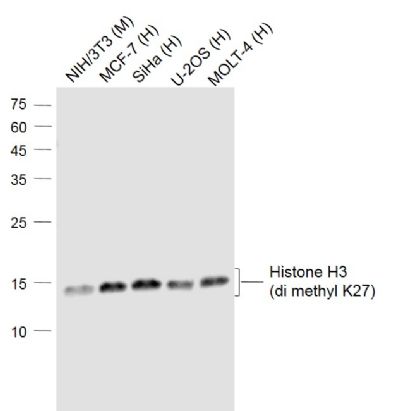
Lane 1: NIH/3T3(Mouse) Cell Lysate at 30 ug
Lane 2: MCF-7 (Human) Cell Lysate at 30 ug
Lane 3: SiHa (Human) Cell Lysate at 30 ug
Lane 4: U-2OS (Human) Cell Lysate at 30 ug
Lane 5: MOLT-4 (Human) Cell Lysate at 30 ug
Primary: Anti-Histone H3(di methyl K27) (bsm-33107M) at 1/1000 dilution
Secondary: IRDye800CW Goat Anti-Mouse IgG at 1/20000 dilution
Predicted band size: 17 kD
Observed band size: 15 kDSample:
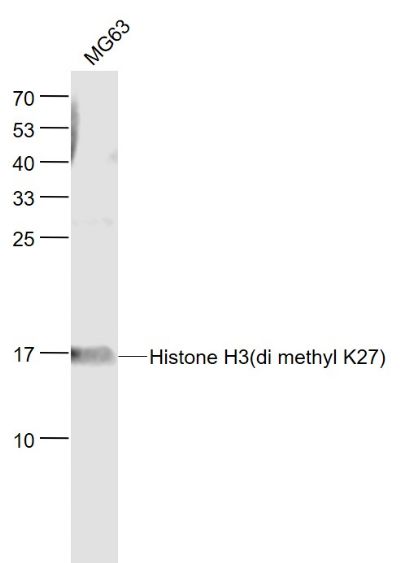
MG63(Human) Cell Lysate at 30 ug
Primary: Anti- Histone H3(di methyl K27) (bsm-33107M) at 1/1000 dilution
Secondary: IRDye800CW Goat Anti- Mouse IgG at 1/20000 dilution
Predicted band size: 15 kD
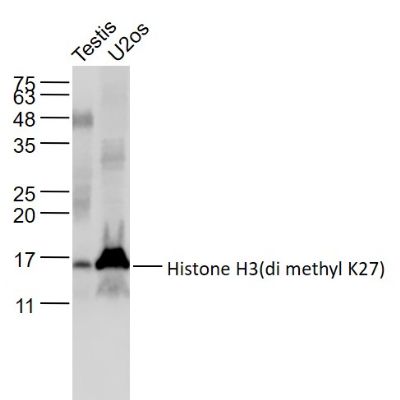
Observed band size: 17 kDTestis (Mouse) Lysate at 40 ug
U2os(Mouse) Cell Lysate at 30 ug
Primary: Anti- Histone H3(di methyl K27) (bsm-33107M) at 1/1000 dilution
Secondary: IRDye800CW Goat Anti-Mouse IgG at 1/20000 dilution
Predicted band size: 15 kD
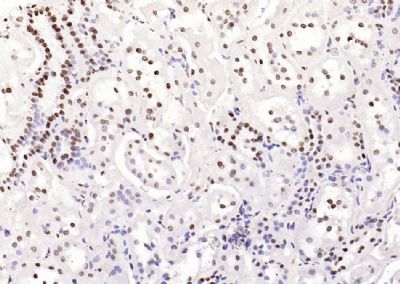
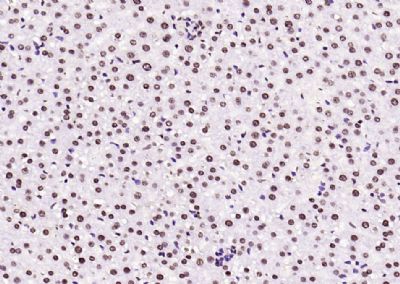
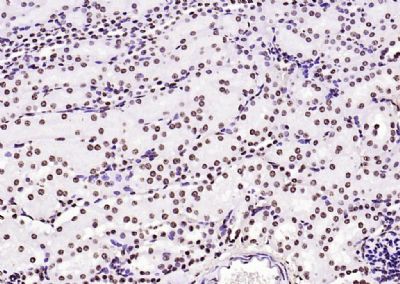
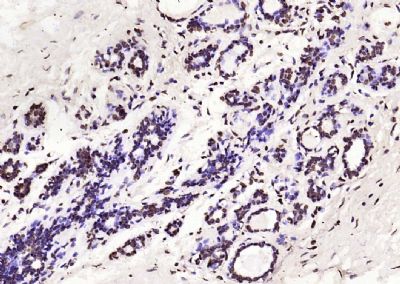
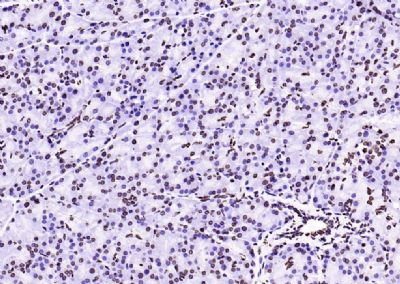
Observed band size: 15 kDParaformaldehyde-fixed, paraffin embedded (rat kidney); Antigen retrieval by boiling in sodium citrate buffer (pH6.0) for 15min; Block endogenous peroxidase by 3% hydrogen peroxide for 20 minutes; Blocking buffer (normal goat serum) at 37°C for 30min; Antibody incubation with (Histone H3(di methyl K27)) Monoclonal Antibody, Unconjugated (bsm-33107M) at 1:200 overnight at 4°C, followed by operating according to SP Kit(Mouse)(sp-0024) instructionsand DAB staining.Paraformaldehyde-fixed, paraffin embedded (rat liver); Antigen retrieval by boiling in sodium citrate buffer (pH6.0) for 15min; Block endogenous peroxidase by 3% hydrogen peroxide for 20 minutes; Blocking buffer (normal goat serum) at 37°C for 30min; Antibody incubation with (Histone H3(di methyl K27)) Monoclonal Antibody, Unconjugated (bsm-33107M) at 1:200 overnight at 4°C, followed by operating according to SP Kit(Mouse)(sp-0024) instructionsand DAB staining.Paraformaldehyde-fixed, paraffin embedded (mouse kidney); Antigen retrieval by boiling in sodium citrate buffer (pH6.0) for 15min; Block endogenous peroxidase by 3% hydrogen peroxide for 20 minutes; Blocking buffer (normal goat serum) at 37°C for 30min; Antibody incubation with (Histone H3(di methyl K27)) Monoclonal Antibody, Unconjugated (bsm-33107M) at 1:200 overnight at 4°C, followed by operating according to SP Kit(Mouse)(sp-0024) instructionsand DAB staining.Paraformaldehyde-fixed, paraffin embedded (human breast); Antigen retrieval by boiling in sodium citrate buffer (pH6.0) for 15min; Block endogenous peroxidase by 3% hydrogen peroxide for 20 minutes; Blocking buffer (normal goat serum) at 37°C for 30min; Antibody incubation with (Histone H3(di methyl K27)) Monoclonal Antibody, Unconjugated (bsm-33107M) at 1:200 overnight at 4°C, followed by operating according to SP Kit(Mouse)(sp-0024) instructionsand DAB staining.Paraformaldehyde-fixed, paraffin embedded (rat pancreas); Antigen retrieval by boiling in sodium citrate buffer (pH6.0) for 15min; Block endogenous peroxidase by 3% hydrogen peroxide for 20 minutes; Blocking buffer (normal goat serum) at 37°C for 30min; Antibody incubation with (Histone H3(di methyl K27)) Monoclonal Antibody, Unconjugated (bsm-33107M) at 1:200 overnight at 4°C, followed by operating according to SP Kit(Mouse)(sp-0024) instructionsand DAB staining.Paraformaldehyde-fixed, paraffin embedded (rat colon); Antigen retrieval by boiling in sodium citrate buffer (pH6.0) for 15min; Block endogenous peroxidase by 3% hydrogen peroxide for 20 minutes; Blocking buffer (normal goat serum) at 37°C for 30min; Antibody incubation with (Histone H3(di methyl K27)) Monoclonal Antibody, Unconjugated (bsm-33107M) at 1:200 overnight at 4°C, followed by operating according to SP Kit(Mouse)(sp-0024) instructionsand DAB staining.Paraformaldehyde-fixed, paraffin embedded (rat liver); Antigen retrieval by boiling in sodium citrate buffer (pH6.0) for 15min; Block endogenous peroxidase by 3% hydrogen peroxide for 20 minutes; Blocking buffer (normal goat serum) at 37°C for 30min; Antibody incubation with (Histone H3(di methyl K27)) Monoclonal Antibody, Unconjugated (bsm-33107M) at 1:200 overnight at 4°C, followed by operating according to SP Kit(Mouse)(sp-0024) instructionsand DAB staining.Paraformaldehyde-fixed, paraffin embedded (mouse liver); Antigen retrieval by boiling in sodium citrate buffer (pH6.0) for 15min; Block endogenous peroxidase by 3% hydrogen peroxide for 20 minutes; Blocking buffer (normal goat serum) at 37°C for 30min; Antibody incubation with (Histone H3(di methyl K27)) Monoclonal Antibody, Unconjugated (bsm-33107M) at 1:200 overnight at 4°C, followed by operating according to SP Kit(Mouse)(sp-0024) instructionsand DAB staining.Paraformaldehyde-fixed, paraffin embedded (Mouse colon); Antigen retrieval by boiling in sodium citrate buffer (pH6.0) for 15min; Block endogenous peroxidase by 3% hydrogen peroxide for 20 minutes; Blocking buffer (normal goat serum) at 37°C for 30min; Antibody incubation with (Histone H3(di methyl K27)) Monoclonal Antibody, Unconjugated (bsm-33107M) at 1:400 overnight at 4°C, followed by a conjugated secondary (sp-0024) for 20 minutes and DAB staining.Paraformaldehyde-fixed, paraffin embedded (Rat liver); Antigen retrieval by boiling in sodium citrate buffer (pH6.0) for 15min; Block endogenous peroxidase by 3% hydrogen peroxide for 20 minutes; Blocking buffer (normal goat serum) at 37°C for 30min; Antibody incubation with (Histone H3(di methyl K27)) Monoclonal Antibody, Unconjugated (bsm-33107M) at 1:400 overnight at 4°C, followed by a conjugated secondary (sp-0024) for 20 minutes and DAB staining.Paraformaldehyde-fixed, paraffin embedded (human colon); Antigen retrieval by boiling in sodium citrate buffer (pH6.0) for 15min; Block endogenous peroxidase by 3% hydrogen peroxide for 20 minutes; Blocking buffer (normal goat serum) at 37°C for 30min; Antibody incubation with (Histone H3(di methyl K27)) Monoclonal Antibody, Unconjugated (bsm-33107M) at 1:200 overnight at 4°C, followed by operating according to SP Kit(Mouse)(sp-0024) instructionsand DAB staining.Paraformaldehyde-fixed, paraffin embedded (human gastric carcinoma); Antigen retrieval by boiling in sodium citrate buffer (pH6.0) for 15min; Block endogenous peroxidase by 3% hydrogen peroxide for 20 minutes; Blocking buffer (normal goat serum) at 37°C for 30min; Antibody incubation with (Histone H3(di methyl K27)) Monoclonal Antibody, Unconjugated (bsm-33107M) at 1:200 overnight at 4°C, followed by operating according to SP Kit(Mouse)(sp-0024) instructionsand DAB staining.Paraformaldehyde-fixed, paraffin embedded (mouse pancreas); Antigen retrieval by boiling in sodium citrate buffer (pH6.0) for 15min; Block endogenous peroxidase by 3% hydrogen peroxide for 20 minutes; Blocking buffer (normal goat serum) at 37°C for 30min; Antibody incubation with (Histone H3(di methyl K27)) Monoclonal Antibody, Unconjugated (bsm-33107M) at 1:200 overnight at 4°C, followed by operating according to SP Kit(Mouse)(sp-0024) instructionsand DAB staining.?