
?胎盤鈣黏蛋白(P-cadherin)重組蛋白說明書
Recombinant Placental Cadherin (P-cadherin)??
[ PROPERTIES ]
Residues: Gly371~Leu660 (Accession # P22223),
with N-terminal His-Tag.
Host: E. coli
Subcellular Location: Cell membrane;
Single-pass type I membrane protein.
Purity: >95%
Endotoxin Level: <1.0EU per 1μg
(determined by the LAL method).
Formulation: Supplied as lyophilized form in 20mM Tris,
500mM NaCl, pH8.0, containing 1mM EDTA, 1mM DTT,
0.01% sarcosyl, 5% trehalose, and preservative.
Predicted isoelectric point: 4.8
Predicted Molecular Mass: 33.4kDa
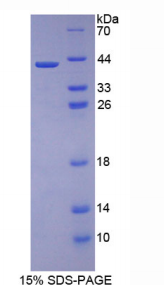
Accurate Molecular Mass: 42kDa as determined by SDS-PAGE reducing conditions.
Applications: SDS-PAGE; WB; ELISA; IP.
(May be suitable for use in other assays to be determined by the end user.)
Note: The possible reasons that the actual band size differs from the predicted are as follows:
1. Splice variants: Alternative splicing may create different sized proteins from the same gene.
2. Relative charge: The composition of amino acids may affects the charge of the protein.
3. Post-translational modification: Phosphorylation, glycosylation, methylation etc.
4. Post-translation cleavage: Many proteins are synthesized as pro-proteins, and then cleaved togive the active form.
5. Polymerization of the target protein: Dimerization, multimerization etc.
[ USAGE ]
Reconstitute in sterile PBS, pH7.2-pH7.4.
[ STORAGE AND STABILITY ]
Storage: Avoid repeated freeze/thaw cycles.
Store at 2-8oC for one month.
Aliquot and store at -80oC for 12 months.
Stability Test: The thermal stability is described by the loss rate of the targetprotein. The loss rate was determined by accelerated thermal degradation test,that is, incubate the protein at 37oC for 48h, and no obvious degradation andprecipitation were observed. (Referring from China Biological Products Standard,which was calculated by the Arrhenius equation.) The loss of this protein is lessthan 5% within the expiration date under appropriate storage condition.
[ SEQUENCES ]
The target protein is fused with N-terminal His-Tag, its sequence is listed below.
MGHHHHHHSG SEF -GDDGDHFTIT THPESNQGIL TTRKGLDFEA KNQHTLYVEVTNEAPFVLKL PTSTATIVVH VEDVNEAPVF VPPSKVVEVQ EGIPTGEPVC VYTAEDPDKENQKISYRILR DPAGWLAMDP DSGQVTAVGT LDREDEQFVR NNIYEVMVLA MDNGSPPTTGTGTLLLTLID VNDHGPVPEP RQITICNQSP VRQVLNITDK DLSPHTSPFQ AQLTDDSDIYWTAEVNEEGD TVVLSLKKFL KQDTYDVHLS LSDHGNKEQL TVIRATVCDC HGHVETCPGPWKGGFILPVL
[ REFERENCES ]
1. Shimoyama Y., et al. (1989) J. Cell Biol. 109:1787-1794.
2. Jarrard D.F., et al. (1997) Clin. Cancer Res. 3:2121-2128.
?3. Shimoyama Y., et al. (1989) Cancer Res. 49:2128-2133.
4. Sprecher E., et al. (2001) Nat. Genet. 29:134-136.
本產品僅供科研使用。不能用于人和動物治療等其它臨床診斷使用