
在當前生物藥物靶點研究領域中,IL-4與IL-13作為T輔助細胞2型(Th2)細胞因子家族的核心成員,正逐步走到臺前,成為眾多炎性疾病和自身免疫病治療的新突破口。
近岸蛋白推出人源、鼠源、猴源及多標簽的IL-4、IL-4RA、IL-13、IL-13RA1/L-13RA2 靶點蛋白,專為抗體藥物早期開發(fā)的免疫與篩選環(huán)節(jié)設計。我們的靶點抗原經過嚴格活性驗證,并搭配參考抗體及穩(wěn)轉細胞株,助力科研人員高效構建高親和力、高特異性的抗體藥物。此外,公司提供從抗體發(fā)現、表達純化到功能驗證的一站式服務,全面賦能IL-4/IL-13通路藥物研發(fā),加速您的研發(fā)進程。
靶點綜述 炎癥與免疫調控中的關鍵角色
IL-4與IL-13不僅是過敏性炎癥的重要調節(jié)因子,還在類風濕性關節(jié)炎(RA)、系統(tǒng)性紅斑狼瘡(SLE)、銀屑病關節(jié)炎(PsA)等自身免疫疾病中發(fā)揮關鍵作用[1]。研究發(fā)現,這兩種細胞因子能夠下調多種促炎細胞因子的表達,包括IL-1、IL-6、TNF-α等[2],并抑制Th17細胞的分化及其促炎因子的釋放,從而在調控免疫平衡、緩解病理性炎癥反應中發(fā)揮抗炎作用[3]。
隨著對IL-4/IL-13通路在免疫調節(jié)中的作用機制的深入認識,多個靶向該通路的抗體類藥物相繼進入市場或臨床開發(fā)階段。這些藥物主要用于治療以Th2型免疫反應異常為核心機制的疾病,涵蓋過敏性疾病(如哮喘、特應性皮炎)及部分自身免疫性疾病。
市場前沿 IL-4/IL-13通路藥物研發(fā)進展
目前,全球多個靶向IL-4/IL-13通路的抗體藥物已進入臨床或實現商業(yè)化。早在2017年,賽諾菲與再生元聯合開發(fā)的IL-4Rα單抗度普利尤單抗(Dupilumab)獲批上市,2024年銷售額突破140億美元。國內方面,康諾亞的司普奇拜單抗于2024年獲批上市,成為第一個國產IL-4Rα抗體藥物;齊魯制藥的QL2108已進入III期臨床。其他如輝瑞(PF-07275315)和北京偉德杰等公司也在積極推進相關靶點布局,充分驗證了IL-4/IL-13通路的臨床價值與市場前景。

圖1. IL-4/IL-4RA/IL-13/IL13RA靶點藥物臨床進展
(來源藥渡數據)
核心因子解析 IL-4與IL-13的結構與功能
01 IL-4:早期發(fā)現,功能多樣的免疫調節(jié)因子
IL-4最早于1982年被發(fā)現,具有誘導小鼠B細胞增殖的能力,其人源IL-4基因位于染色體5q31,與IL-13、IL-3、IL-5、IL-9等Th2相關因子基因簇相鄰[4]。IL-4的結構為四螺旋束(four-helixbundle),含有三個二硫鍵,其成熟蛋白分子量為約15.4kD[5]。功能上,IL-4不僅可促進B細胞增殖,還能刺激IgE和IgG4的免疫球蛋白類別轉換[6],活化嗜酸性粒細胞、肥大細胞和嗜堿性粒細胞,并誘導Th2細胞的分化。此外,它還能誘導成纖維細胞產生膠原,促進血管內皮細胞表達粘附分子(VCAM-1),參與組織修復與重塑[7]。
02 IL-13:結構相似,功能互補的“搭檔”
IL-13于1983年首次在小鼠活化Th2細胞中被發(fā)現,1993年克隆出人源基因。它同樣是一種四螺旋束細胞因子,在結構上與IL-4有25%的氨基酸序列相似度,功能上也有部分重疊。IL-13具有誘導粘液分泌、杯狀細胞化生和平滑肌細胞收縮的作用,這些機制在氣道重塑過程中尤為重要。此外,它也能刺激成纖維細胞合成膠原,促進慢性炎癥中的組織纖維化進程[8]。同IL-4一樣,IL-13也能抑制多種促炎因子和趨化因子的表達,如IL-8、MCP-3、IP-10、MIP-3等,同時調控巨噬細胞向抗炎表型極化(M2型)[9]。這些作用使其在自身免疫性疾病、如銀屑病、I型糖尿病、實驗性自身免疫性腦脊髓炎(EAE)等動物模型中展現出潛在的治療價值。
信號通路機制 共用受體下的多元調控
IL-4與IL-13的生物活性主要通過與各自的受體結合后激活下游信號通路來實現。它們共享一個二型受體(type II receptor),該受體由IL-4Rα與IL-13Rα1兩個亞基組成,能夠結合IL-4或IL-13發(fā)揮信號傳導功能。此外IL-4還可以與I型受體(type I receptor)結合,該受體由IL-4Rα與通用γ鏈(γC)組成,僅IL-4可識別。IL-13也能結合IL-13Rα2,該受體被認為是一個“誘餌”受體,不參與經典信號通路。當IL-4或IL-13與其受體結合后,會激活Janus激酶家族(JAK1,JAK2,JAK3),繼而磷酸化信號轉導與轉錄激活因子STAT6,使其轉位入核,調控多種免疫穩(wěn)態(tài)維持與炎癥抑制相關的基因。此外,還可能激活STAT3、PI3K以及MAPK等其他信號通路,調節(jié)更廣泛的細胞功能[1]。
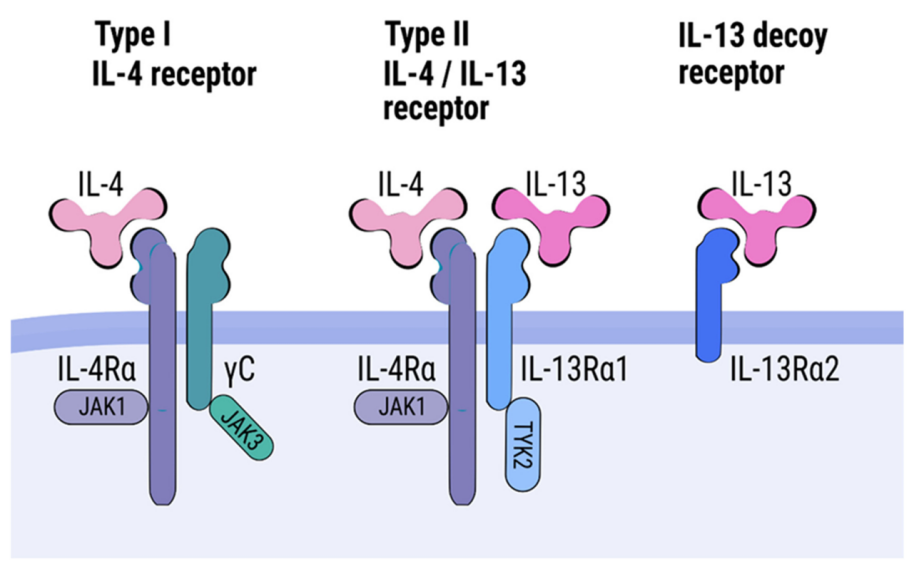
圖2. IL-4與IL-13的受體機制[1]
部分數據展示
經過SEC-HPLC驗證
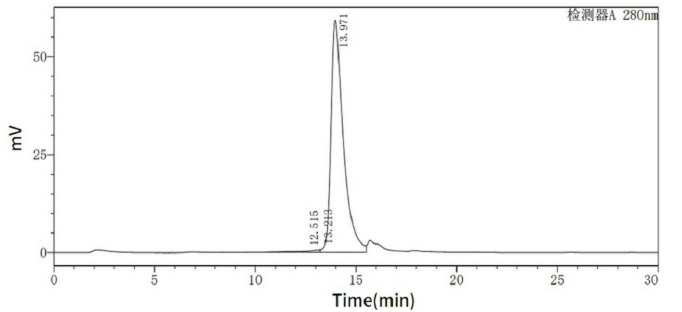
Greater than 95% as determined by SEC-HPLC.(QC verified)
經過ELISA驗證
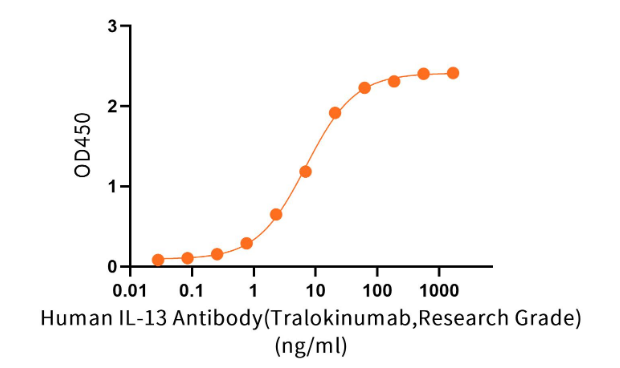
Immobilized Recombinant Cynomolgus IL-13 (C-6His)(Cat.No.:C37G) at 1 μl/ml (100 μl/well) can bind Anti-Human IL-13 Antibody (TRA_bio,Research Grade)(Cat.No.:NC359).The ED50 of Anti-Human IL-13 Antibody (TRA_bio,Research Grade)(Cat.No.:NC359) is 7.05 ng/ml.(Regularly tested).
經過批間穩(wěn)定性驗證
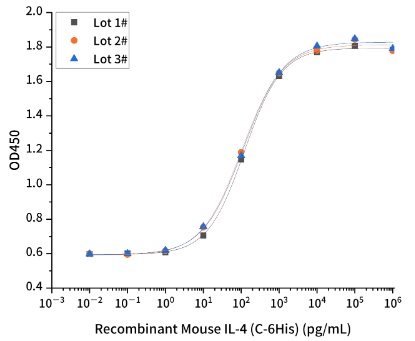
Measured in a cell proliferation assay using M-NFS-60 mouse lymphoblast cells.Three independent lots were tested for activity and plotted on the same graph to show lot-to-lot consistency of IL-4.
經過Cell Based Assay驗證
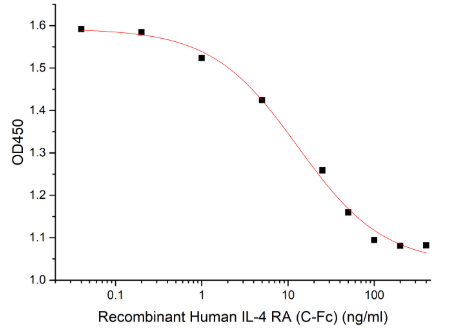
Measured by its ability to inhibit IL-4-dependent proliferation of TF?1 human erythroleukemic cells.The ED50 for this effect is 5-20 ng/ml. (QC verified)
經過BLI驗證
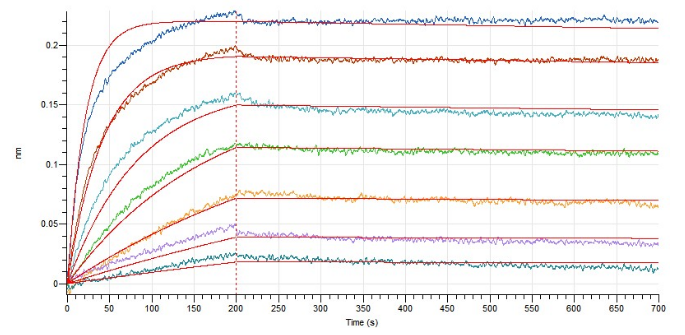
Loaded Human IL-4-His(Cat.No.:CX88) on HIS1K Biosensor, can bind Human IL-4RA-Fc(Cat.No.:CS38) with an affinity constant of 0.12 nM as determined in BLI assay.
相關產品
| Cat.No. | Product Name | Tag |
| CX88 | Recombinant Human IL-4 | C-6His |
| CK74 | Recombinant Mouse IL-4 | C-6His |
| GMP-CD03 | Recombinant Human IL-4 | Tag Free |
| CC89 | Recombinant Human IL-13 | C-6His |
| C37G | Recombinant Cynomolgus IL-13 | C-6His |
| CX56 | Recombinant Mouse IL-13 (110AA) | C-6His |
| CS32 | Recombinant Human IL-13RA1 | C-6His |
| CB12 | Recombinant Mouse IL-13RA1 | C-Fc |
| C38U | Recombinant Human IL-13RA2 | C-Fc |
| C43H | Recombinant Mouse IL-13RA2 | C-Fc |
| CS38 | Recombinant Human IL-4 RA | C-Fc |
| CB94 | Recombinant Human IL-4 RA | C-mFc |
| CS33 | Recombinant Human IL-4 RA | C-6His |
| C939 | Recombinant Cynomolgus IL-4RA | C-Fc |
| C938 | Recombinant Cynomolgus IL-4RA | C-6His |
| CB03 | Recombinant Mouse IL-4RA | C-Fc |
| C08R | Recombinant Mouse IL-4RA | C-6His |
| CY142 | Biotinylated Human IL-4RA | C-Avi-6His |
| CY141 | Biotinylated Human IL-4 | C-6His-Avi |
| CB13 | Biotinylated Mouse IL-13RA1 | C-Avi-6His |
| NC359 | Anti-Human IL-13 Antibody (TRA_bio, Research Grade) | - |
| NC232 | Anti-Human IL-4RA Antibody (DUP_bio, Research Grade) | - |
參考文獻
[1] Bogunia-Kubik K. Significance of Interleukin (IL)-4 and IL-13 in Inflammatory Arthritis[J].Cells, 10(11):3000[2025-05-22].DOI:10.3390/cells10113000.
[2] Hershey G K K. Hershey, GK. IL-13 receptors and signaling pathways: an evolving web. J Allergy Clin Immunol 111: 677-690; quiz 691[J].Journal of Allergy and Clinical Immunology, 2003, 111(4):677-90; quiz 691.DOI:10.1067/mai.2003.1333.
[3] D,C,Newcomb, et al. A Functional IL-13 Receptor Is Expressed on Polarized Murine CD4+ Th17 Cells and IL-13 Signaling Attenuates Th17 Cytokine Production[J].The Journal of Immunology, 2009, 182(9).DOI:10.4049/jimmunol.0803868.
[4] Howard, M. Identification of a T cell-derived b cell growth factor distinct from interleukin 2.[J].Journal of Experimental Medicine, 1982, 155(3):914-923.DOI:10.1084/jem.155.3.914.
[5] Walter M R, Cook W J, Zhao B G, et al. Crystal structure of recombinant human interleukin-4[J].Journal of Biological Chemistry, 1992, 267(28):20371-20376.DOI:10.2210/pdb2int/pdb.
[6] Nandayapa M. Prendas de un idioma crepuscular: versión original del prefacio de Atalazor de Vicente Huidobro[J].Journal of Experimental Medicine, 2006, 173(3):747-50.DOI:10.1084/jem.173.3.747.
[7] Harakati M S E. Pernicious Anemia in Arabs[J].Blood Cells Molecules & Diseases, 1996, 22(2):98.DOI:10.1006/bcmd.1996.0015.
[8] Endo T A, Masuhara M, Yokouchi M, et al. A new protein containing an SH2 domain that inhibits JAK kinases.[J].Nature, 1997, 387(6636):921-924.DOI:10.1038/43213.
[9] Funes, Samanta, C, et al. Implications of macrophage polarization in autoimmunity[J].
Immunology An Official Journal of the British Society for Immunology, 2018.